
THE AUTOBIOGRAPHY OF A SCHOOLBOY
A MEMOIR BY THOMAS TOMKINS, XI
Presented here with his kind permission is Chapter Eleven of the hitherto unpublished memoir of his youth of a retired English publisher written under the pen name Thomas Tomkins and finished in 2026.
[Return to the beginning of this memoir]
Chapter Eleven
The holidays ended, and I entered the Classical Fifth. The mode of teaching had changed; we were expected to keep up with difficult and demanding work. I took Greek and German as well as the other Humanities. Mathematics was still compulsory, but even this was made more palatable by the fact that many of its first principles had been worked out by Greek philosophers including Euclid and of course Pythagoras. It amused me on one occasion to hand in some work on Euclid’s theorems written not in English but in Greek. I received – quite justly – a sharp scolding and gave myself the extra work of doing the work again in English. Yet even then it was a helpful exercise. I began at that time to realise, very slowly and uncertainly, that all knowledge is related, and that things learned in one 'subject' might illuminate things learned in another.
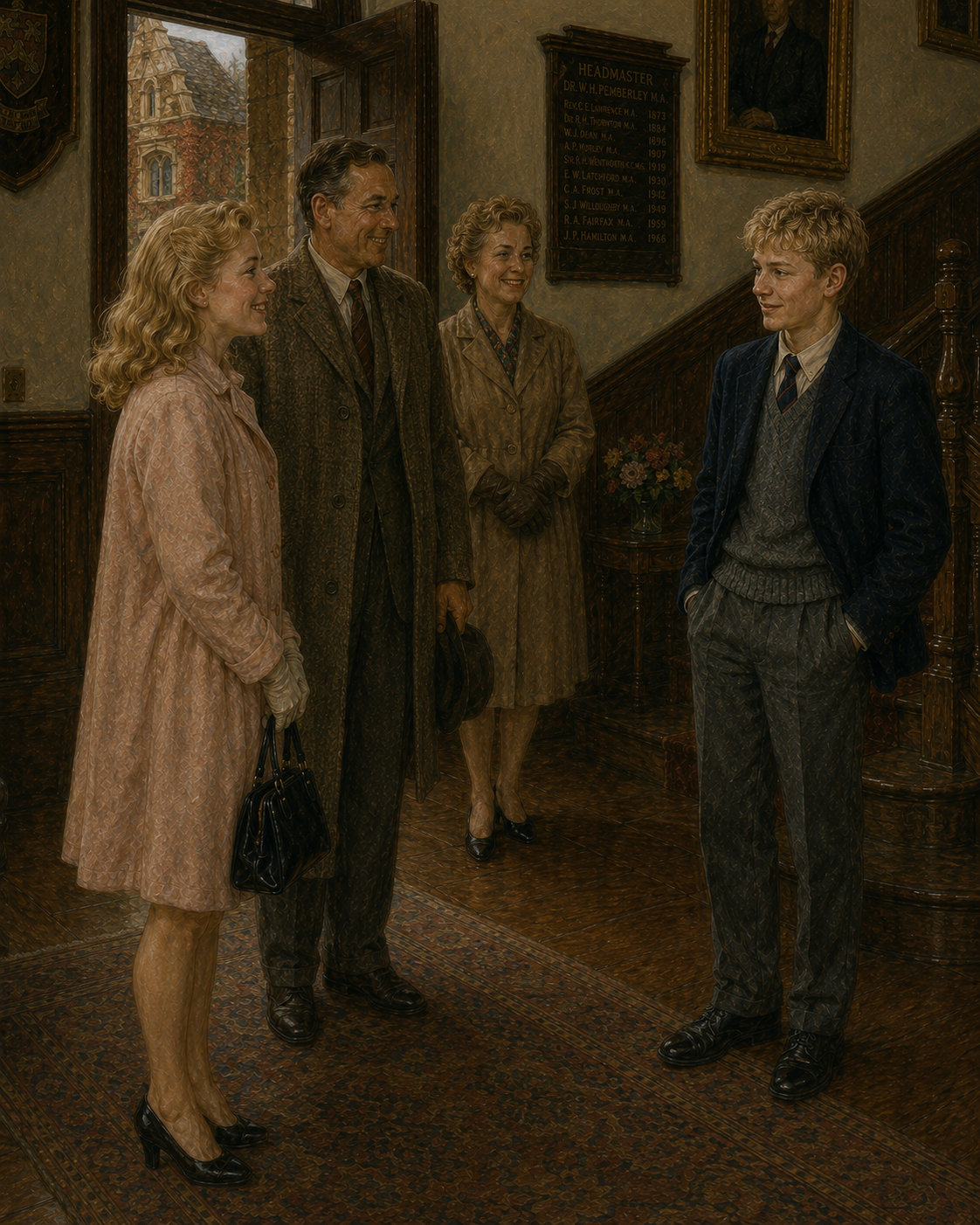
Garbin had left to go on to Oxford, where he became Organ Scholar at one of the colleges. He was to go on eventually to become Organist at one of the English Cathedrals where he had quite a distinguished career. I had had an affectionate parting from him at the end of the previous term, and indeed when we met on one or two occasions as adults our relations were easy and pleasant. By that time I was too large and too hirsute to be of interest to older boys, and I took no interest in Flopsies. Jack Tonks was in his final year, and I continued to fulfil his wants from time to time, though there were several other boys equally willing to take advantage of his capacious arse. And I had undoubtedly begun to notice girls, though I was still far too diffident to approach one. There was one particular girl, the older sister of one of my classmates, who was a perfect English Rose, fair-haired and with a pink and white complexion. She filled my thoughts for days on end each time I saw her. I wonder what became of her; the likelihood is that she married and produced beautiful children. For anything I know to the contrary, she could be the mother of one of my sons’ classmates.
I kept up my correspondence with Allan. I think he was glad to be able to have a pupil, even at a distance, who called upon his knowledge of Classical language and culture. No Greek was taught at St Mark’s, and Latin only to Common Entrance or Scholarship level. It must have been frustrating for him to be teaching pupils who, however intelligent, were starting from scratch and who left the school as soon as they were becoming really proficient.
Now that my mother was on her own, I felt that I ought to spend more time with her in London. My father, since his downfall, had been as much of a hindrance as a help, although he did deal with the heavier lifting and carrying. However, since she no longer had his drinking habits to support, and it turned out that early in their marriage he had taken out a small life insurance policy in her favour, it was possible for her to employ a “daily woman” to do the rough cleaning and jobs such as laying and lighting fires.
Looking back, I am slightly surprised that I was not expected to leave Flamborough and live permanently at home, attending a local day school. I think the explanation is that she was able to talk about “my son at Public School” which would have appealed to her snobbish instincts, whereas the local state secondary school had no cachet whatever.
So the half term exeat and the greater part of the Christmas holiday were spent in London, though I did get a few days with Allan towards the end of the holiday. We sat up to see the New Year in, the first time I had ever done that. We still slept together in his bed, though our sexual activities were less frequent but longer lasting and more thoughtful. I wondered if he were becoming enamoured of another St Mark’s boy, and if so who the lucky individual was.
Back at school for the Lent term, I continued with my studies. I found Greek hard going at first because of the unfamiliar alphabet, but once I had mastered that it yielded up its treasures a little at a time. By now I was almost as fluent in Latin as I was in English and was from time to time commended for my Latin verses. I had discovered the English poets of the twentieth century and revelled in T. S. Eliot – I suspect this was because I enjoyed his obscurity more than anything else – but also fell in love with the metaphysical poets of the Tudor period: Traherne, Vaughan and especially George Herbert. Even now I read them for pleasure.
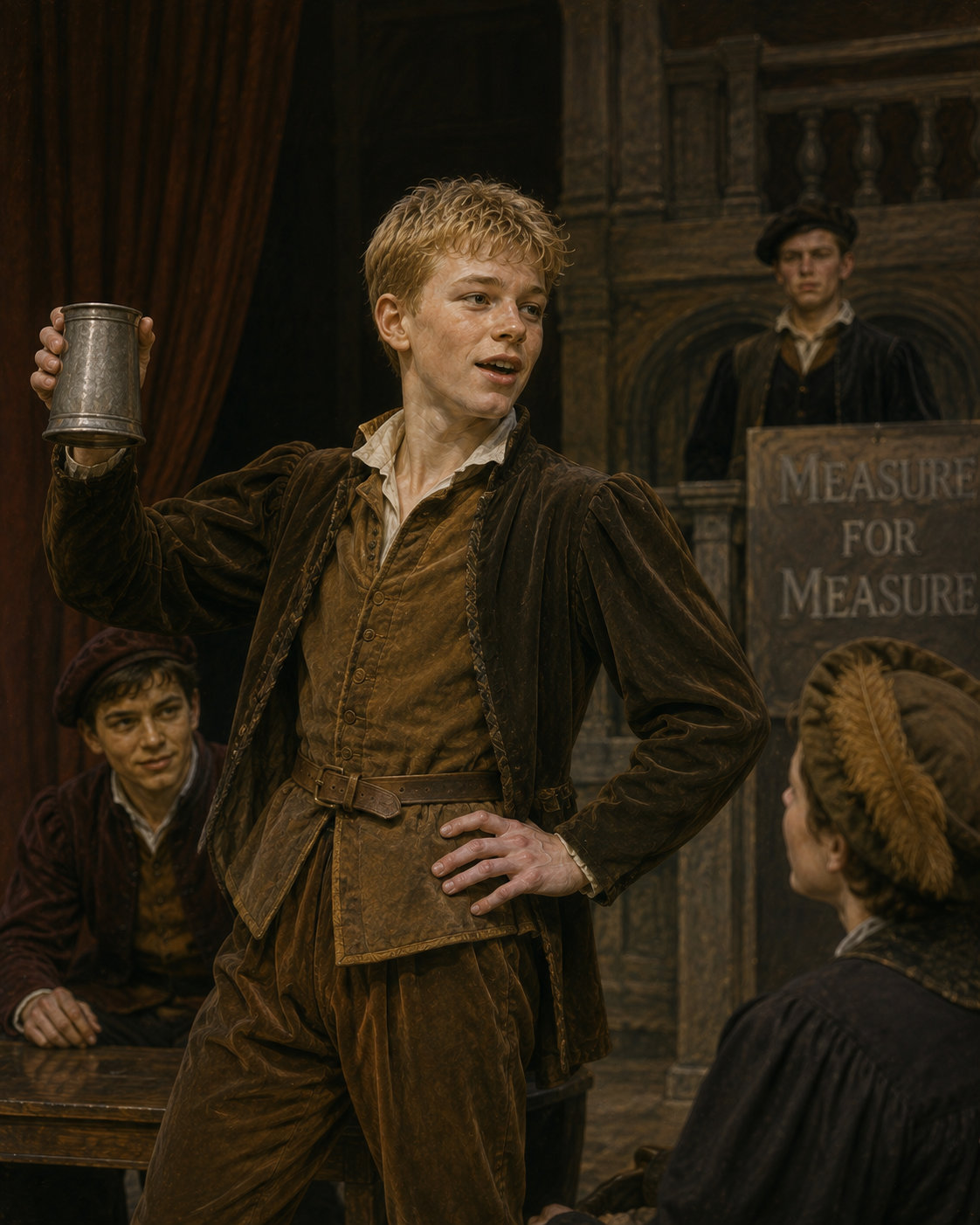
The School Play that year was Measure for Measure, which I still think one of the Bard’s finest works. Pleading pressure of work, I avoided taking a large part, but I was cast as Froth, a foolish gentleman who spent much of his time drinking in ale-houses. It was a good production: Mr Challen, who produced it, took some trouble over diction and delivery which paid dividends in making the plot intelligible.
The Easter holiday came, and as it was a short one that year, only ten days, I spent it in London, promising myself a good long time with Allan in the summer. We still kept up our correspondence, and I was able to telephone him once or twice from home. I made it my task to clear out and tidy the repellent little hidey-hole that did duty for an office, and to get the paperwork into some sort of order. My mother went out each morning to shop, and now that my father was no longer there, it provided an excellent opportunity to use the telephone discreetly. I don’t think my mother noticed the periodical slight increase in the telephone bill, but if she did she was probably hoping that I was in contact with a “nice girl”.
What a curious term that is. In my mother’s vocabulary, it meant one from a family claiming to be upper-middle or upper class, who was demure, sexually rather cold (or at least with the appearance of being so) and if possible pretty.
Back at school for the Summer Term, a monumental uproar blew up over two boys who were caught in flagrante delicto. Fortunately, it was in another House. But as I understand it, a boy in the Lower Sixth, one Johnson, had been pursuing a fourth-form Flopsy by the name of Keene rather too assiduously. The younger boy eventually gave way to Johnson’s entreaties, but a friend of his had mentioned his concerns to his Housemaster. The Housemaster, dutifully patrolling his House, heard noises from a dormitory when no boy should have been there, and put his head round the door, only to see Johnson being vigorously fellated by young Keene.
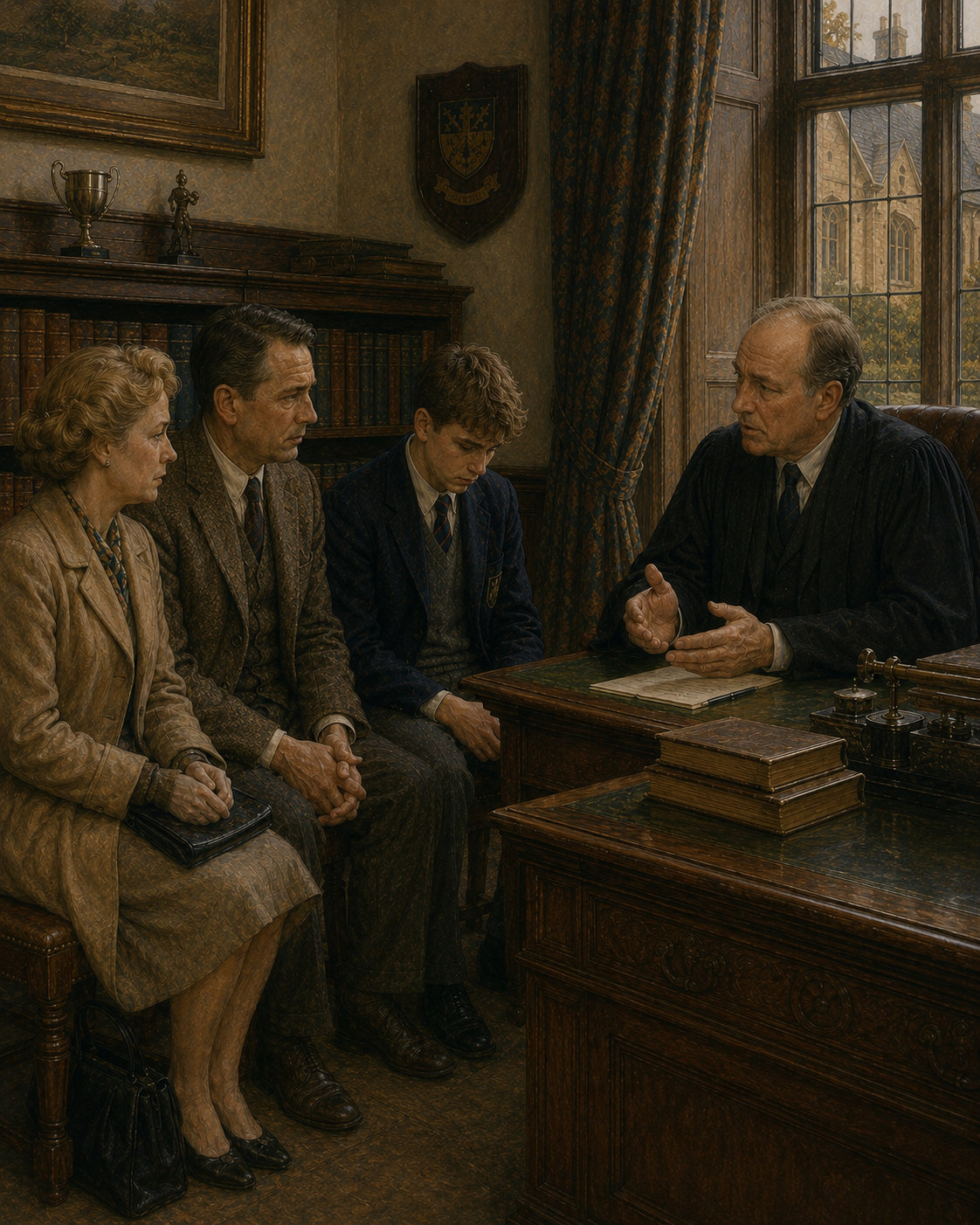
Of course, the poor man had to take action. Johnson was expelled there and then; his parents were summoned to an interview with the Headmaster and were brusquely told to remove him without delay. The unfortunate Keene had a painful interview with the Headmaster, after which he was examined by the School Doctor. He was absent for some days, after which he was allowed to return, but placed in another House. It was asserted that he had been “forced” by Johnson to participate in his “disgusting practices” and that therefore it was not his own fault. We knew differently, but kept quiet on the subject. However, the Headmaster did call the entire school to the Chapel and addressed us, with some discreet skirting around the precise details of the subject, and promised that any boy caught “misbehaving in this way” would be instantly removed from the School.
After this, even Tonks behaved with great circumspection, allowing himself to be buggered only occasionally, and at a time and in a place where detection was improbable. And all of the seniors in Hervey’s, and presumably the other Houses as well, left their Flopsies well alone. A lot of nonsense was talked about a “healthy moral tone” and a few of the more smug and self-satisfied (in more senses than one) boys indulged in much smirking at other boys’ expense.
But this illustrates the bad results of the noisy moral outrage in which many people indulge at others’ (never their own) peccadilloes. Two boys, or perhaps a small group of boys, disappear into the bushes or the boot-room. Much fun is had and no harm is done. The boys grow up, leave school and find adult relationships; probably most of them will marry. They will be the better lovers for having had the opportunity of youthful experimentation in a harmless milieu, and the boys concerned learn to use their tackle in a pleasurable and considerate way.
But consider what happens when moral authority finds out and trumpets its outrage to the world. Boys are expelled, in all probability wrecking their school, university and even work career. Parents are bewildered, and the boys concerned made to feel a degree of moral guilt utterly out of proportion to their original acts. And for the younger boys it may be even worse. Instead of being (what most of them are) willing participants, they are cast in the role of victims. Subjected to medical examination, even psychological analysis – and I believe today, when things are considerably worse than they were when I was at Flamborough, compelled to submit to “counselling” – which has the effect mainly of confusing them and making them feel perplexed and guilty about their quite natural adolescent sexuality. Immense harm is done all round. The few occasions upon which a younger boy is persuaded or constrained by an older to engage in an activity which he really dislikes can generally be dealt with by the Housemaster or someone else in authority having a quiet but firm word with the individual or individuals concerned. As the celebrated actress Mrs Patrick Campbell put it: “Does it really matter what these affectionate people do, as long as they don’t do it in the street and frighten the horses?”
Continue to Chapter Twelve
Comments powered by CComment