
THE AUTOBIOGRAPHY OF A SCHOOLBOY
A MEMOIR BY THOMAS TOMKINS, XIII
Presented here with his kind permission is Chapter Thirteen of the hitherto unpublished memoir of his youth of a retired English publisher written under the pen name Thomas Tomkins and finished in 2026.
[Return to the beginning of this memoir]
Chapter Thirteen
Over the following terms I found that I was actually beginning to enjoy my cross-country running. Having had so solitary a childhood, I was quite happy in my own company, and the bodily exercise thus afforded to me was a powerful stimulant to thought. I began to understand the use of Revision in study; it is useless if regarded as the last chance to learn what should have been learned thoroughly beforehand, but if the work has been done properly in the first place, revision allows the student to link up different parts of his knowledge, to see how one piece of work can shed light on another and even to make connections between different subject areas.
By now I was well into my adolescence and my sexual urges were maturing. I no longer needed frequent masturbation, but when I did indulge in it my physical pleasure was the greater. I was fortunate in having a study to myself. Mr Greenhalgh, the Housemaster of Hervey's, was still near enough to his own Public School days to appreciate a senior boy’s need for privacy and would knock on a boy’s study door before entering. On two occasions I was interrupted by a fellow Sixth former and blithely informed “you’ll go blind”, but there can have been few if any Studies which did not carry the evidence of ejaculation upon their carpets and among ourselves it was not a matter for comment. On the whole my year group were a mature and intelligent set of boys and it was accepted, among the Scholars at any rate, that work was to be taken seriously.
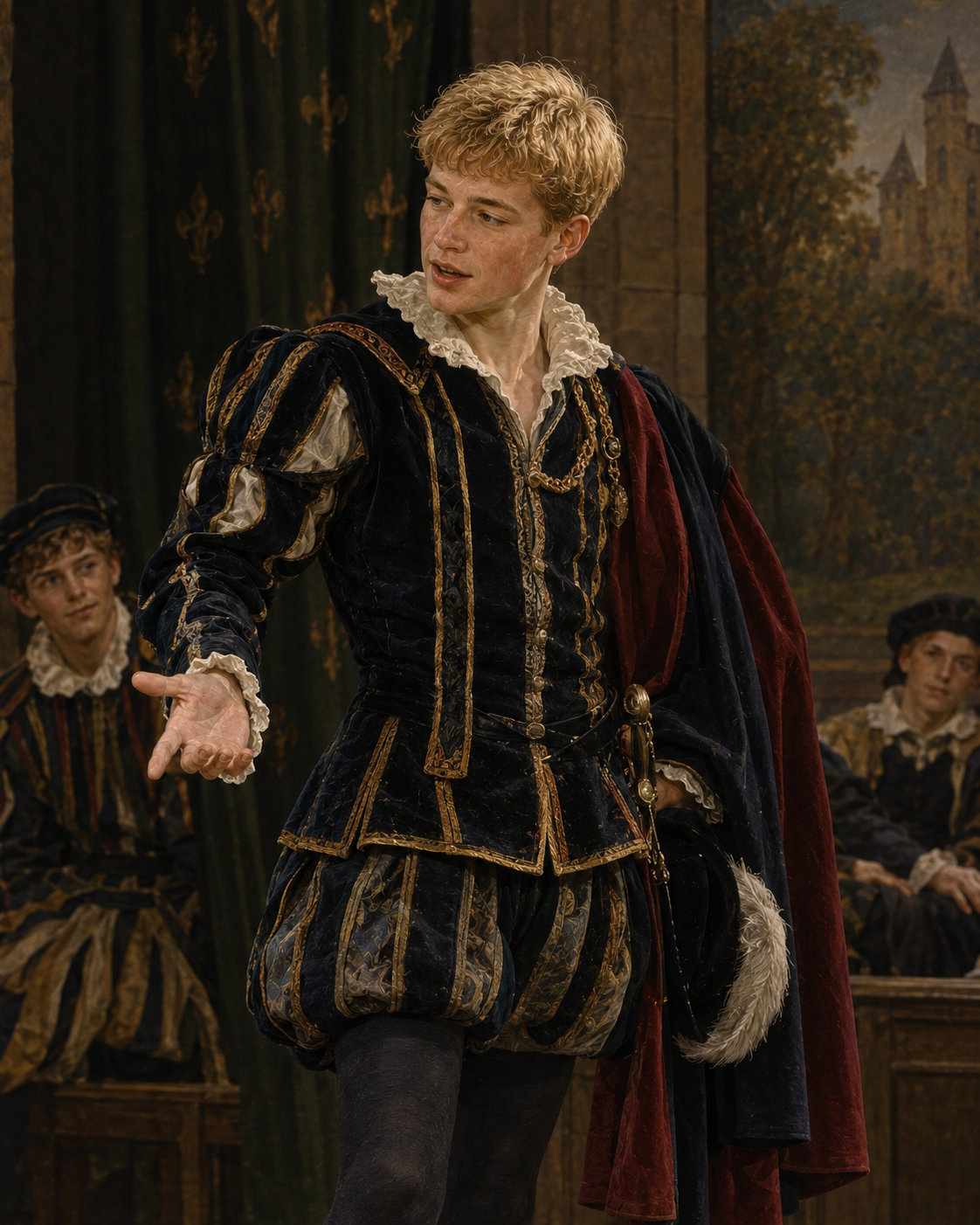
This year’s School Play, again produced by Mr Challen, was Love’s Labours Lost, and as I was well on with my work I agreed to take a larger part: I was cast as Lord Dumaine. I was, I believe, a competent rather than an inspired actor, but I enjoyed the play.
The Easter holiday, again, was spent mostly at home, but my Uncle Tom Fane, who was now running the family estate in East Anglia, took it into his head to invite me to spend a few days with him and his family. Having had almost no contact with any relatives for most of my life, I accepted willingly but a little nervously. I need not have worried, the Fanes were easy-going, cheerful folk, as unlike my mother as could be imagined. They had a daughter, Fenella, who was just a little younger than I. She was a pretty, rather demure girl and I adored her instantly. I was still too young and bashful to propose anything more adventurous than a walk to her. Poor girl! I must have bored her to tears. I was far too diffident to offer her any compliments; instead I held forth about my life at Flamborough and my no doubt ridiculous notions on many subjects. What would have happened if I had tried to kiss her? I suspect she would have screamed, slapped my face or both. But I remember her fondly because she was my first female friend of my own age, and she had great tact and maturity for her years.
The start of the Summer Term, inevitably, brought some serious work as I needed to lay the foundations for my final year at Flamborough. It was obvious that I should wish to go on to a University, and my first choice was, of course, Cambridge. However, although County Council grants were available to undergraduates, they covered little more than the University fees and it was obvious that as my mother had no money to spare I should have to obtain a full Scholarship. The masters were cautiously optimistic but gave me to understand that there would be stiff competition and my results would have to be quite exceptional if I were to be given a major award.
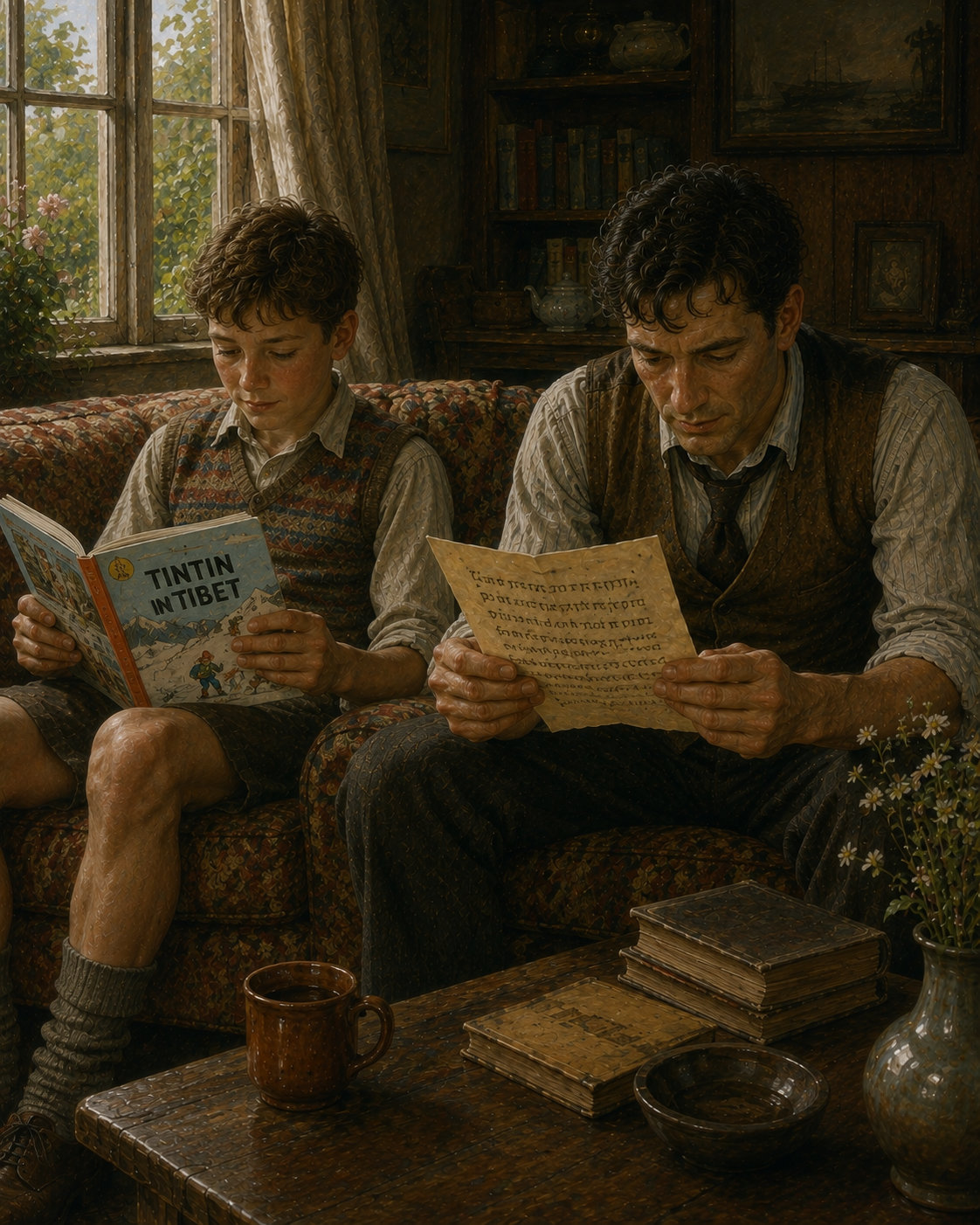
Well, work was no great hardship and once again I got my head down over my books. Two of the masters were kind enough to give me some extra tuition on an occasional basis. By now I was sufficiently fluent in Greek to write to Allan in that language, and his replies, always welcome, were hugely helpful as they contained corrections and suggestions to advance my knowledge. I even sent him Latin verses which he evidently enjoyed immensely.
At any Public School, the Summer term is always the best. The slog of academic work is out of the way and Revision is the order of the day. The long days, light evenings and fine weather encourage outdoor activity. Sixth Form boys at Flamborough were permitted to walk to the village in twos or threes and a blind eye was turned towards the purchase of edibles. The school food was sufficient in quantity and nourishing enough, but like most institutional food was rather bland and unsatisfying. Large slabs of fruit cake, or bags of apples, bought from the village shop, made up the difference in a most satisfactory manner.
Cross-country running had ceased for the Summer, and cricket was the order of the day. I had to put in two afternoons a week playing this game in a rather desultory way, though if I were on the batting side I was usually put in near the end which meant I could spend most of the time sitting quietly with a book. What was more irksome was having to take my turn in supervising Third or Fourth Form prep. On the whole they were a reasonably peaceable set of boys, though I heard from other Prefects that the boys in one at least of the other Houses were very unruly. We had one or two troublemakers, of course, but our usual way of dealing with them was to separate them from their cronies; deprived of the opportunity to show off, they generally settled down.
All too soon came Examination time, and I got my first taste of the kind of thing I might expect to be faced with in terms of University entrance. I was already considering carefully what subject I should read at University: should it be Classics or English? On the one hand, I was well-read in both modern and older English literature, though my reading did not go much further back than Chaucer and Dunbar; Anglo-Saxon and Beowulf were still unfamiliar and if I were to read English I should have to drop Greek for my final year and do some serious work on Middle English and Anglo-Saxon. On the other hand, I was fluent in Latin and reasonably confident in Greek; my knowledge of Greek and Roman history were fairly solid and I could write Latin verse with ease and Greek verse with at least some ability. I needed to let the School know what I intended to do with my final year. I discussed it with the various masters concerned and also with my Housemaster, but without coming to any very clear conclusion. In the end I wrote a long, detailed letter to Allan, asking his advice.
Allan’s reply, so characteristic of a talented schoolmaster, answered my questions by asking others. In the end I applied for – and was granted – a weekend’s leave of absence, and took myself off to Allan’s cottage where we had arranged to meet. He had been able to get only Saturday afternoon and Sunday free, so I arrived before he did, but as I knew where the spare key was hidden this did not matter.
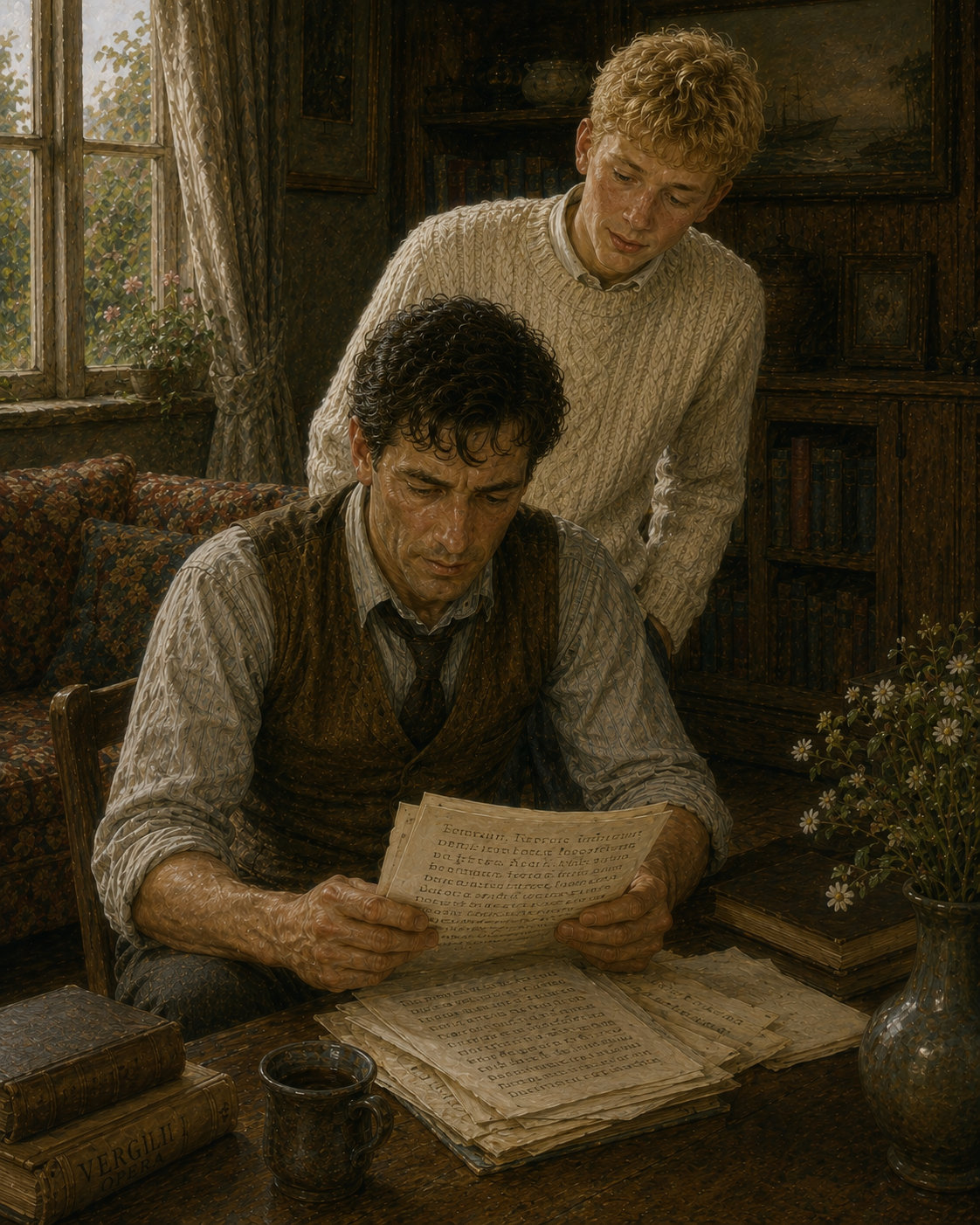
I took some of my recent work for Allan to look over, and he questioned me with great thoroughness. One thing was already clear, that this was an important decision which would have a considerable influence on my future. In the end it became clear that Classics were my real love, with English coming, though closely, second. Before I left on the Sunday afternoon I knew that I should apply for the Classical tripos at Cambridge, and that I should attempt a full Scholarship. Before I left, Allan said, “If you need a quiet place to come and study, come here. If I am here, I won’t disturb you if you are working.”
On a sudden impulse I asked him if it would worry him if I did better at University than he had. His answer shows the greatness of soul that was his. “Heavens, no,” he replied. “I should be disappointed if you didn’t.”
I returned to Flamborough and spoke to my Tutor (who, rather than the Housemaster, was responsible for my academic progress). The decision was made, my studies for my final year would be planned and I was sent on holiday with a stack of reading.
Continue to Chapter Fourteen
Comments powered by CComment