
THE AUTOBIOGRAPHY OF A SCHOOLBOY
A MEMOIR BY THOMAS TOMKINS, IX
Presented here with his kind permission is Chapter Nine of the hitherto unpublished memoir of his youth of a retired English publisher written under the pen name Thomas Tomkins and finished in 2026.
[Return to the beginning of this memoir]
Chapter Nine
I had arranged with Allan Pascoe that I would travel down to Penzance for the second week of the holiday. We arrived at my parents’ house on a Friday, and I soon understood that I was expected to help with the chores involved in looking after guests. The usual population of students had departed, but there were plenty of foreign guests attending Summer Schools at the University.
On the following Monday I left the house as soon as the breakfasts were cooked and eaten, and made my way by Underground to Paddington. Mr Pascoe had privately given me sufficient money for the fares and I felt an unexpected sense of freedom in being able to travel on my own, buying tickets and choosing a seat for myself.
Mr Pascoe was waiting for me at Penzance, and a surprise awaited me – he had acquired a car, a dark green Morris Minor. As he explained, it would be enjoyable for us to be able to go further afield and explore more of Cornwall. I was so delighted to be with him that anything would have pleased me. The first thing he said was, “Now that you and I are no longer master and pupil, I’d be very happy for you to call me Allan.” I thought it better not to say that I’d intended to do this anyway. But I was glad that he’d invited me to do so as it demonstrated that we were becoming more like equals. After this holiday there would be a new School, new masters, new friends, new ways.
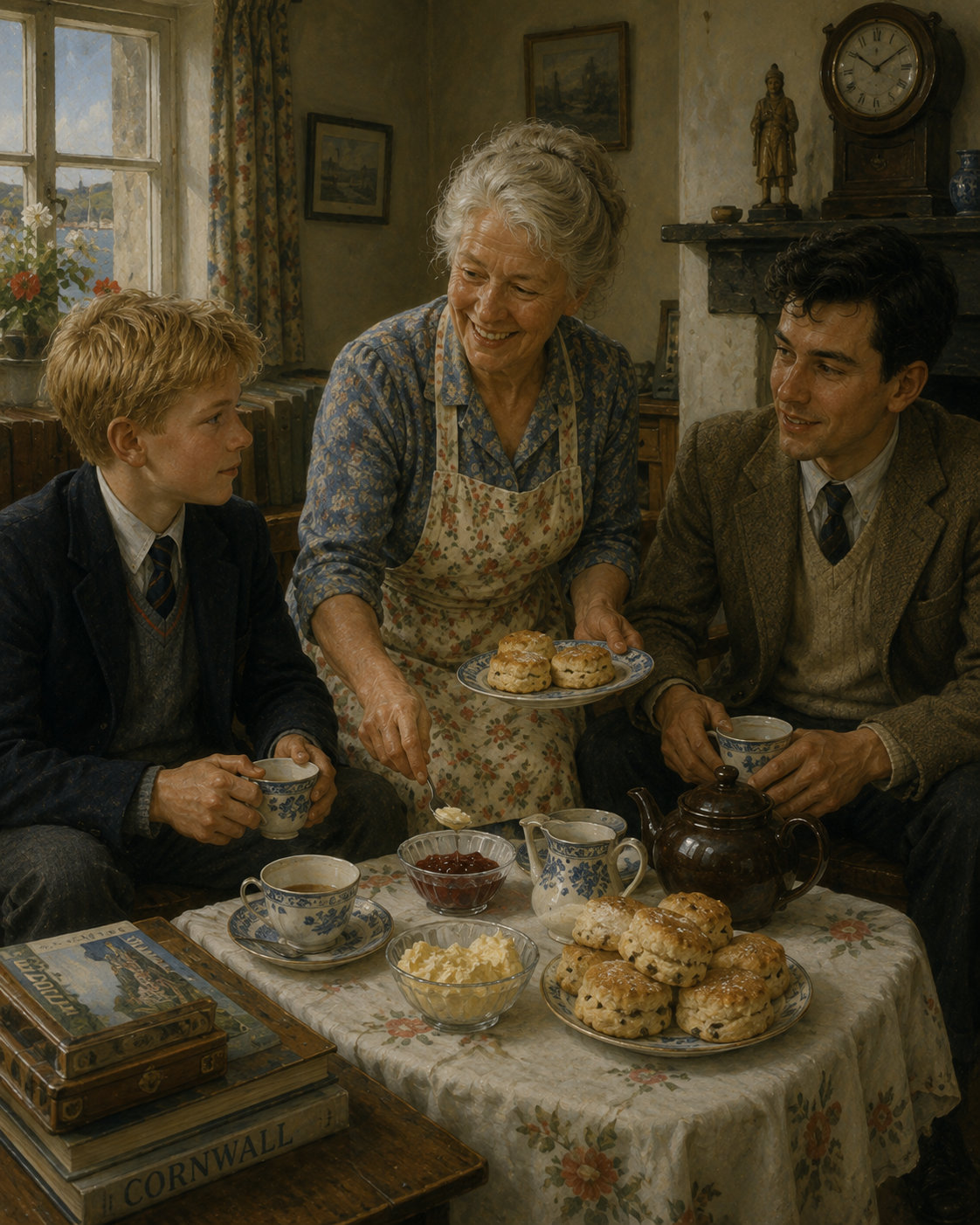
Allan’s mother was just as I had remembered her, merry, white-haired and full of pride, not only in her son but also, to my delight, in me as his pupil. We sat down to a tea of scones, home-made jam and Cornish clotted cream. I looked about the little room, so homely and comfortable, the old lady and her handsome son, whom I loved so dearly, and vowed that one day I should have such a home of my own.
Allan had spoken to me about my staying at his mother's house. I was very welcome, he told me, and would always be welcome, but it was not possible for us to share a bed there as his mother always brought him tea first thing in the morning and would have been shocked to the core to find us together. However, if we wished to be close there were other possibilities.
The next morning I was wakened by Allan, carrying bathing clothes and a large towel. He drove us to the tiny village of Porthcurno which was, he told me, historically important as it was from there that the Italian inventor Marconi sent the first message by wireless across the Atlantic. I never did get round to asking him why an Italian should have chosen a small English village for this purpose!
We stripped naked and bathed in the sea. The weather was gloriously fine and the beach not easily accessible, and we had the place to ourselves. We romped – it is the only possible word – in the water until we were tired, then made our way across the beach to a cave. There, Allan spread a travelling rug upon the ground and, with our damp towels for a pillow, embraced passionately. It was here, on several occasions, that we engaged in mutual oral sex, discovering for ourselves the so-called “sixty-nine” position.
Each morning of that glorious week we drove to Porthcurno, swam, ran, played and made love. And make no mistake, this was truly love. Even now, more than fifty years later I can still capture the essence of that joyous time.
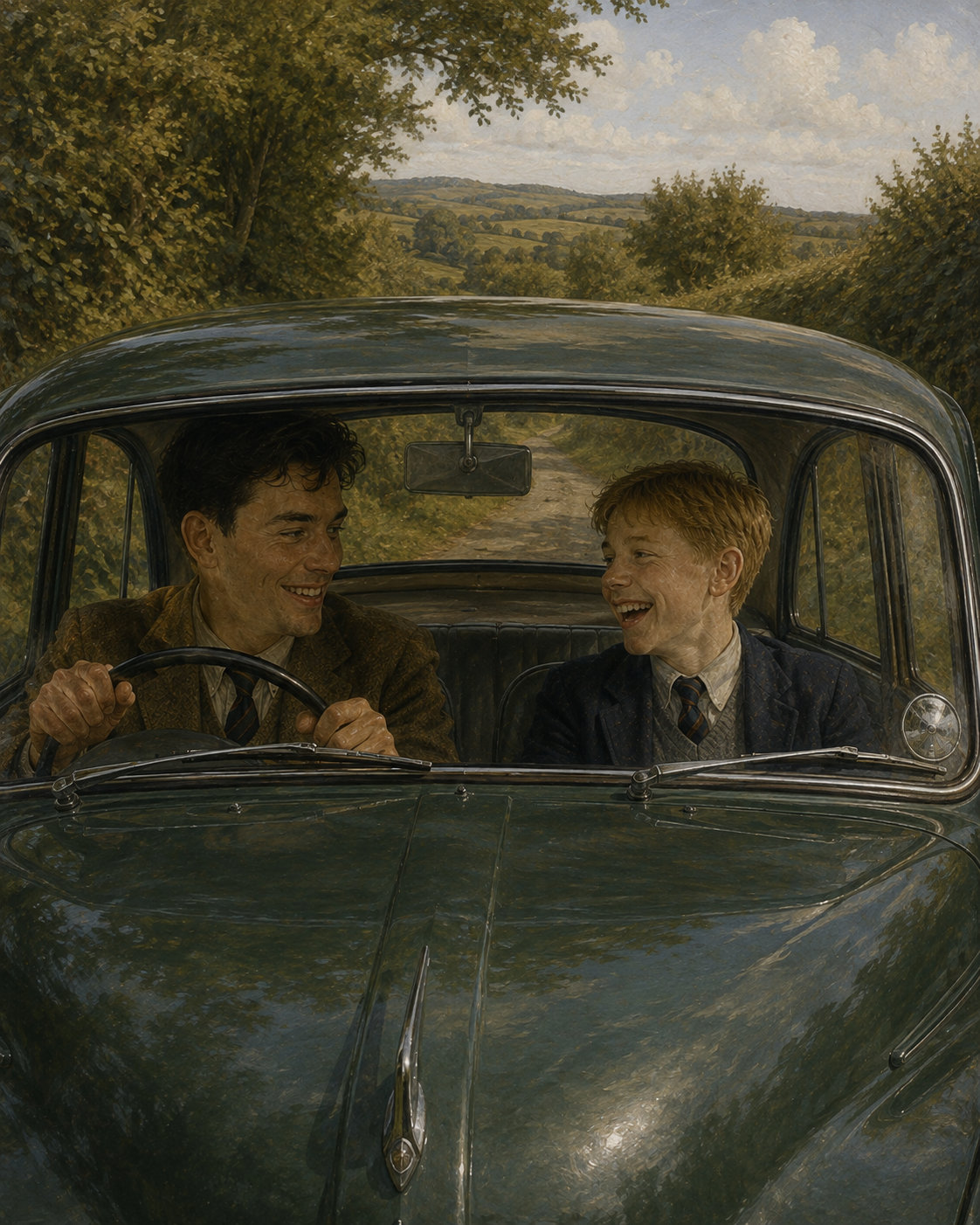
In the daytime we explored Cornwall together, visiting all sorts of places of interest, taking sandwiches and fruit to eat out of doors and cementing a new relationship which was no longer master and pupil but two people on an equal footing. I knew, of course, that it could not last indefinitely; Allan was definitely attracted to younger boys and I was already beginning to eye girls with more than passing interest. But it was still a marvellous time, weaving together the magic of ancient Cornwall with an idyllic physical love and a sense of comradeship which was entirely new to me. This comradeship, often the best part of the relationship between father and grown-up son, is something I had never experienced with my own father, though I know it now with my two sons. It was not my father, but Allan, who gave me this precious gift.
* * *
But of course it had to come to an end. Allan returned me to Penzance station, whence I took the train back to Paddington and my parents’ tall, narrow and rather dingy house. As before, I was expected to help with domestic chores. However, having been taught by Mrs Pascoe how to cook really delicious bacon-and-egg breakfasts, this became my first duty of the day. During later holidays, when the regular students were back in occupation, I was complimented many times on my cookery skills.
Unfortunately, having won my Scholarship and having no academic work set for the holiday, I had few excuses for getting out of the house. I spent a few days with another St Mark’s boy whose uncle and aunt lived in Norwood, but otherwise such leisure time I was able to find was spent at the British Museum, with occasional excursions to the Victoria and Albert and Natural History Museums. I wrote regularly to Allan, who kindly provided me with a sheet of stamps for this purpose, and looked forward daily to his letters. I was generally the first up in the morning, so it was easy enough for me to pick up his letters from the hall floor before my mother appeared with questions as to who was writing to me so regularly. My father, of course, never appeared until mid-morning, by which time he had generally taken enough drink to enable him to face the day. From this time on, I do not believe I ever saw him wholly sober. Like most alcoholics, he had a very considerable capacity and could take an amount of drink which would have floored most men without any visible effect, but he had clearly abandoned any attempt at self-discipline. He did a certain amount of fetching and carrying of coal and other heavier items, but otherwise the whole burden of running the boarding house (for that is in reality what it was) to my mother, with such help as I could give during school holidays.
In practice, I did not particularly resent my domestic servitude. During the summer holiday the usual University students were replaced by foreign visitors attending Summer Schools, and the occasional tourist – foreign or British – looking for in expensive accommodation. Many of the foreign visitors were friendly souls, and many and generous were the tips I received when out of my parents’ earshot.
But of course the time came when I was to move to my new School. The village of Flamborough had no railway station of its own, but students travelling by train were instructed to catch a particular train from Euston, changing at Birmingham, and we would be met at the station in the nearby town. My trunk had gone on ahead by Messrs. Pickford, the carriers, and I had just a modest suitcase to carry with washing things, one change of clothing and – of course! – some books.
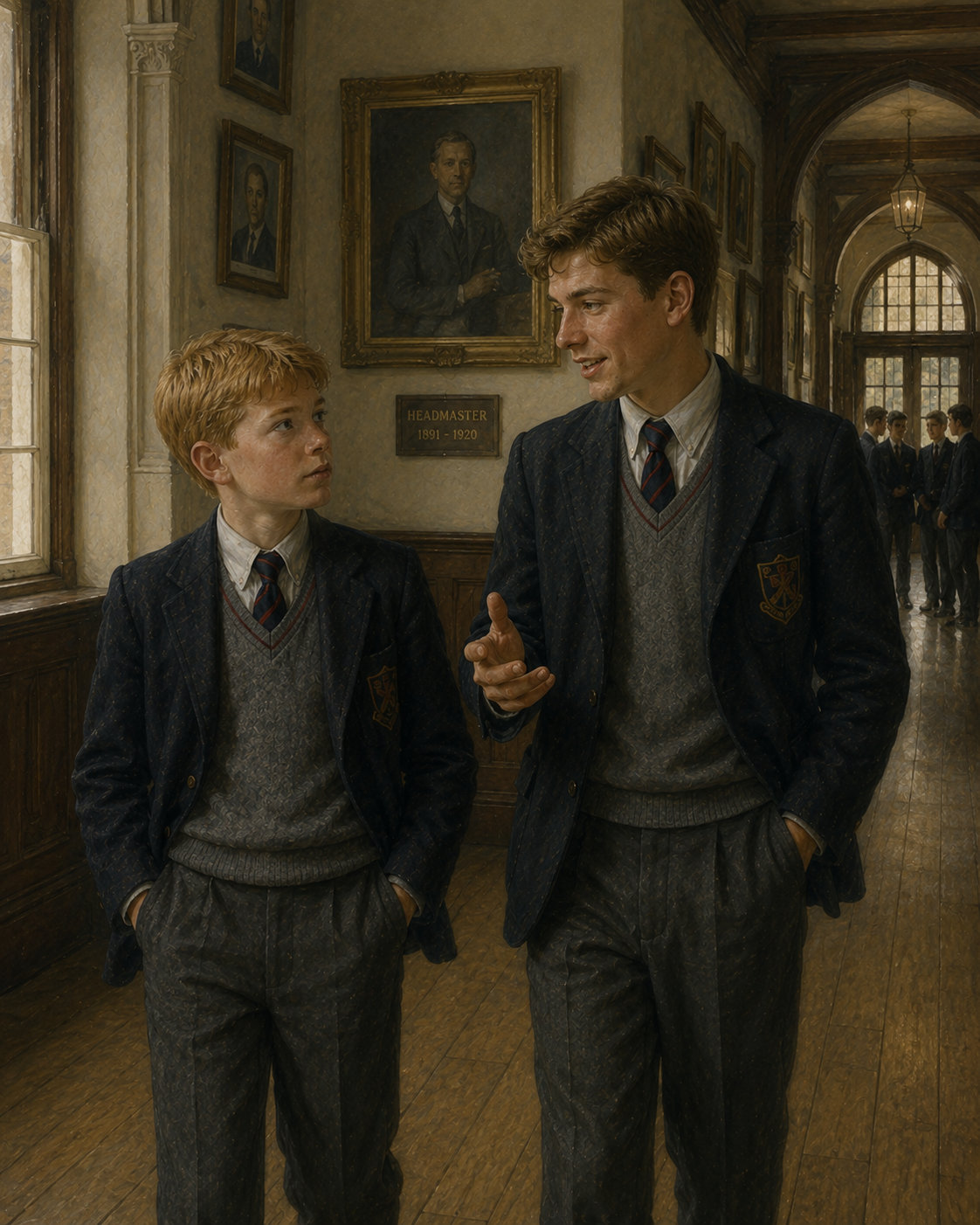
Flamborough had at that time the sensible habit of bringing the new boys each year a day ahead of the others, so that they had a chance to familiarize themselves with the school, the timetable and the meals, before the term proper began. In addition, each new boy had a 'Watchdog', a slightly older boy attached to him who would act as his guardian for a few days until he found his feet. Mine was a pleasant, fair-haired boy named Ellison.
As a Scholar, I had certain privileges from the beginning. I was entitled to use the Library, and it was understood that Scholars, once within the Library, were exempt from ‘fagging’ and other disagreeable duties, and were also – for some obscure historical reason – permitted to walk across a piece of lawn in front of School House which was out of bounds to other boys.
My clothes stored in the Matrons’ ample cupboards, my few personal possessions in my locker, I wandered the school grounds and buildings, memorizing the locations of the classrooms in which I should be taught, the names of the masters, the times of lessons and other fixed points. On the following day the rest of the boys arrived.
Each boy was allocated to a House. This was his home in term-time, the place where he slept, ate and did almost everything except lessons. Games were organized by Houses (and each term saw a flurry of House Matches in which there was far greater rivalry than in matches against other Schools). Each House was provided with a Common Room for each year group from the new boys to the Lower Fifth, as well as Studies for the older boys.
The older boys, usually from the Fifth Form upwards, were allotted Studies, tiny cubicles containing a table, a chair for each boy and a cupboard in which personal possessions could be kept. In some cases these were also used for the storage of food. A few Studies were occupied by three boys, most of them by two. A Scholar in the Sixth Form was accorded the additional privilege of a Study to himself.
I was placed in Hervey’s House, named after its original Victorian housemaster, Dr Clarence Hervey, whose portrait, bewhiskered and austere, hung on the wall opposite the entrance.
After dinner we were supposed to go to our Houses, and most of the evening’s activities were centred about the Common Room. This was equipped with long tables, much inked and notched, forms on which boys sat, and a locker for each boy.
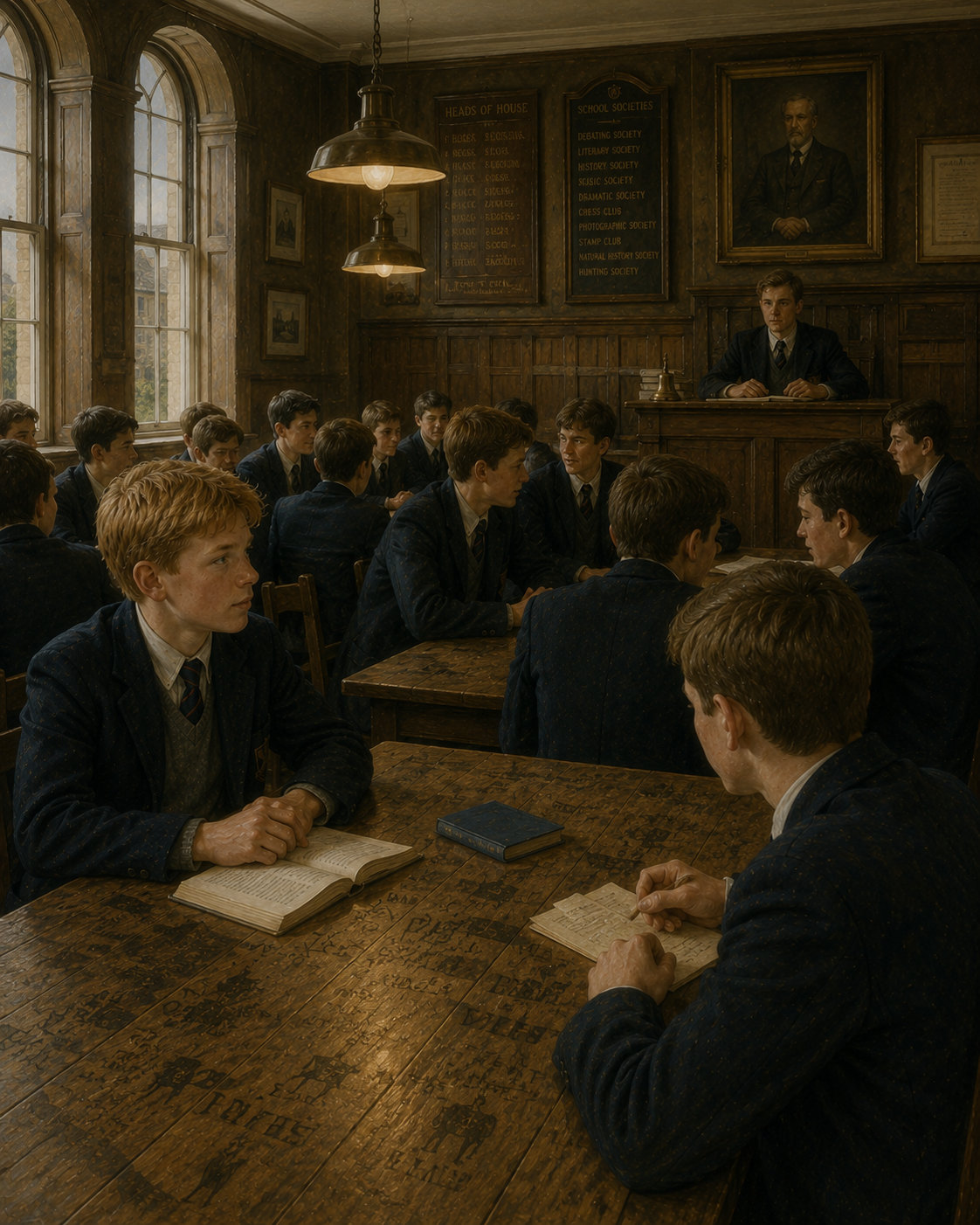
Prep came first, of course, and a Sixth Form boy sat at a raised desk at the end of the room to keep order. Senior boys were no longer permitted to carry or use canes, but the usual punishment for rowdy behaviour was known as “a clip round the ear”. In reality, this was a fairly hefty slap from an open hand upon the side of the head. For a repeat offence, the defaulter might be told to stand in the doorway with one side of his head close to the jamb, and then hit on the opposite side. This, of course, resulted in painful contact on both sides. But as a rule we were a reasonably peaceable set of boys and heavy punishments were rare.
On the other hand, like young boys the world over, we loved to “cheek” our seniors. The usual result of this was a bout of “Fagging”, which usually resulted in the juniors acquiring better manners. useHoues
A note here may be in order about Fagging. Traditionally, a senior boy, known as a “Fag-Master”, could call upon any junior boy, known as a “Fag”, to perform almost any menial task. This had the no doubt beneficial result of preventing any junior from becoming uppity, but did result in at least some juniors becoming so exhausted that they were unable to keep up with their studies, or even, in the worst cases, to keep awake in lessons. However, abuses at some schools, resulting in serious injury to younger boys, had led to the system being revised or, in a few cases, completely abolished.
At Flamborough the system was still in place, but subject to sensible restrictions. A shout of “Fag!” in a corridor still produced a tumult of juniors racing to answer, since it was understood that the last boy to arrive was given the task. But the privilege of calling for a Fag was confined to boys in the Sixth Form, and onerous and pointless duties, such as cleaning studies and cooking extra food, were no longer required. By the time I got there, about the worst that a Fag could be called upon to do was to clean his Fag-Master’s football boots. Though in all conscience this was bad enough as they were required not only to be thoroughly cleaned but to be treated with dubbin and then polished to a high gloss.
On this first day of Full Term I had coped reasonably well. I’d managed to turn up in the right places within a reasonable time, and the masters had seemed, on the whole, reasonable. The Latin master, Dr Learie, was an elderly, acid-tongued man who was, in my admittedly biased opinion, not a patch upon Allan Pascoe. The rooms, too, were large and rather bare, very different from the cosy classrooms at St Mark’s. However, Dr Learie had been grudgingly complimentary about my ability to translate Latin at sight (he did not know that the passages he produced for us were some I had already studied).
There did not seem to be anything in particular on my timetable following the afternoon lessons, so I made my way to the Library and began to find my way around its shelves.
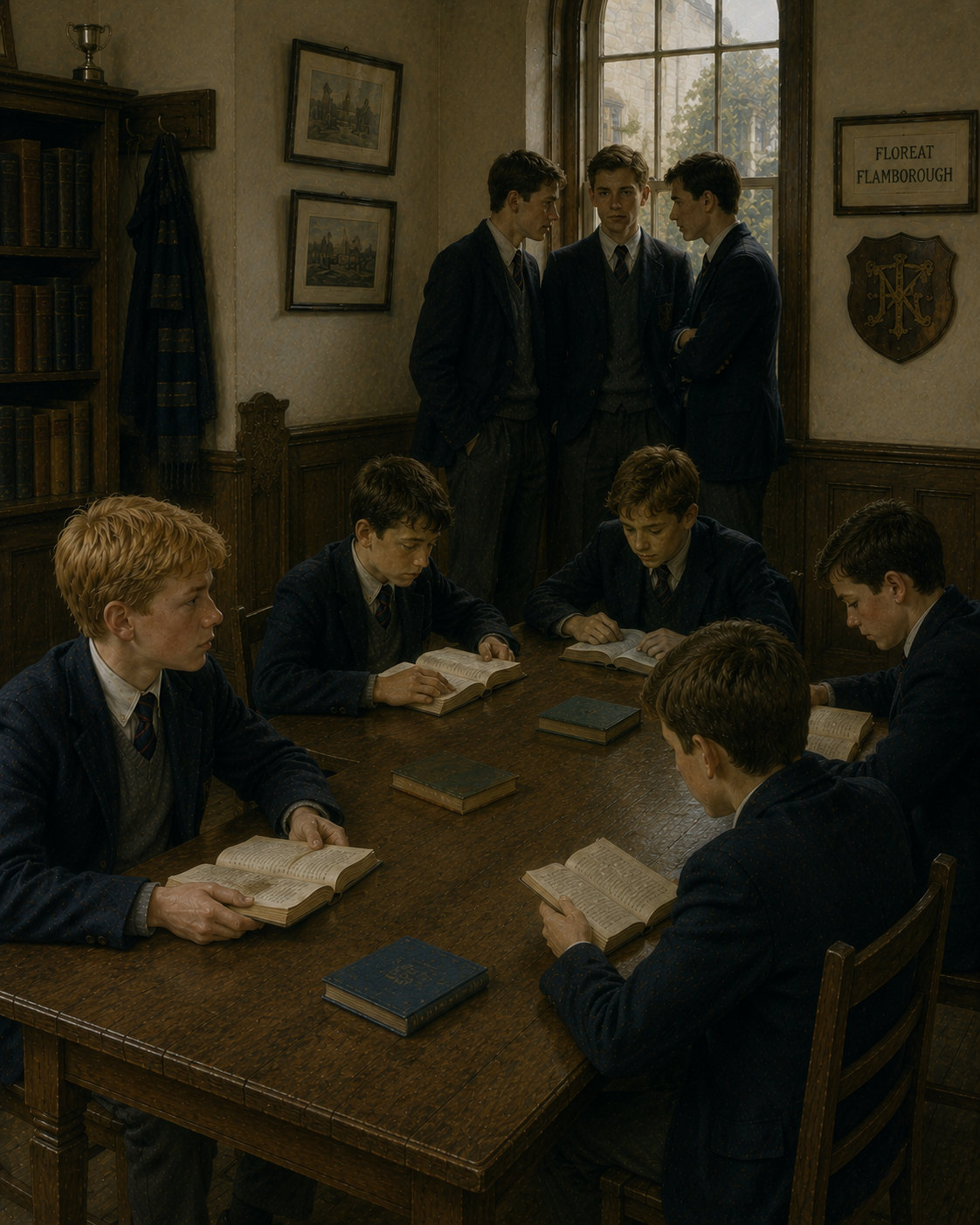
After dinner (the School liked to use the more formal names for meals), I went, as I had been instructed, to the Third Form Common Room in my house, and settled down with my books to tackle the Prep that had been set. After half an hour or so I became aware of a group of senior boys standing to one side and surveying us. It soon became clear why.
How the Headmaster could claim, as he did, that “there is no homosexuality at Flamborough” I have no idea. He was neither a stupid nor a naive man; perhaps his meaning was that homosexuality, if it became known to the authorities, would be punished by expulsion. In reality, sexual activity was widespread throughout the school, and for the most part it took the same form. This was inevitable, since a large number of adolescent boys confined together for several weeks on end will need release for the powerful sexual urges awakening in them. And, on the whole, I believe it to be a good thing, since boys will learn sexual good manners harmlessly with one another before encountering young women. And in a closed society in which power structures are very rigid and abuses can be widespread, this sexual activity can bring in something gentle, fresh and even loving. At worst it is harmless, provided both (or all) parties consent; what does do immense harm is the hysterical uproar that ensues if it is discovered and punished by heavily moralizing authority. Then, boys are made to feel guilty, their school career is blighted, or even ended, and a black mark follows them through their school, university and even work career. No, let teen-aged boys play with one another as they freely choose, and let authority turn a blandly Nelsonian blind eye.
Among the younger boys in the third and fourth forms there were, inevitably, some attractive, perhaps rather feminine, boys. These were known as 'Flopsies' and were the target for the sexual appetites of the more lustful, or less moral, members of the fifth and sixth forms.
I was not unaware that I was a good-looking boy. I had inherited my father’s tall, slender figure, fair hair and pleasant features. I soon picked up, from the sly looks of the senior boys around, that I was attracting some attention. However, I had no interest in anything sexual (though I was masturbating regularly by then) other than my relationship with Allan.
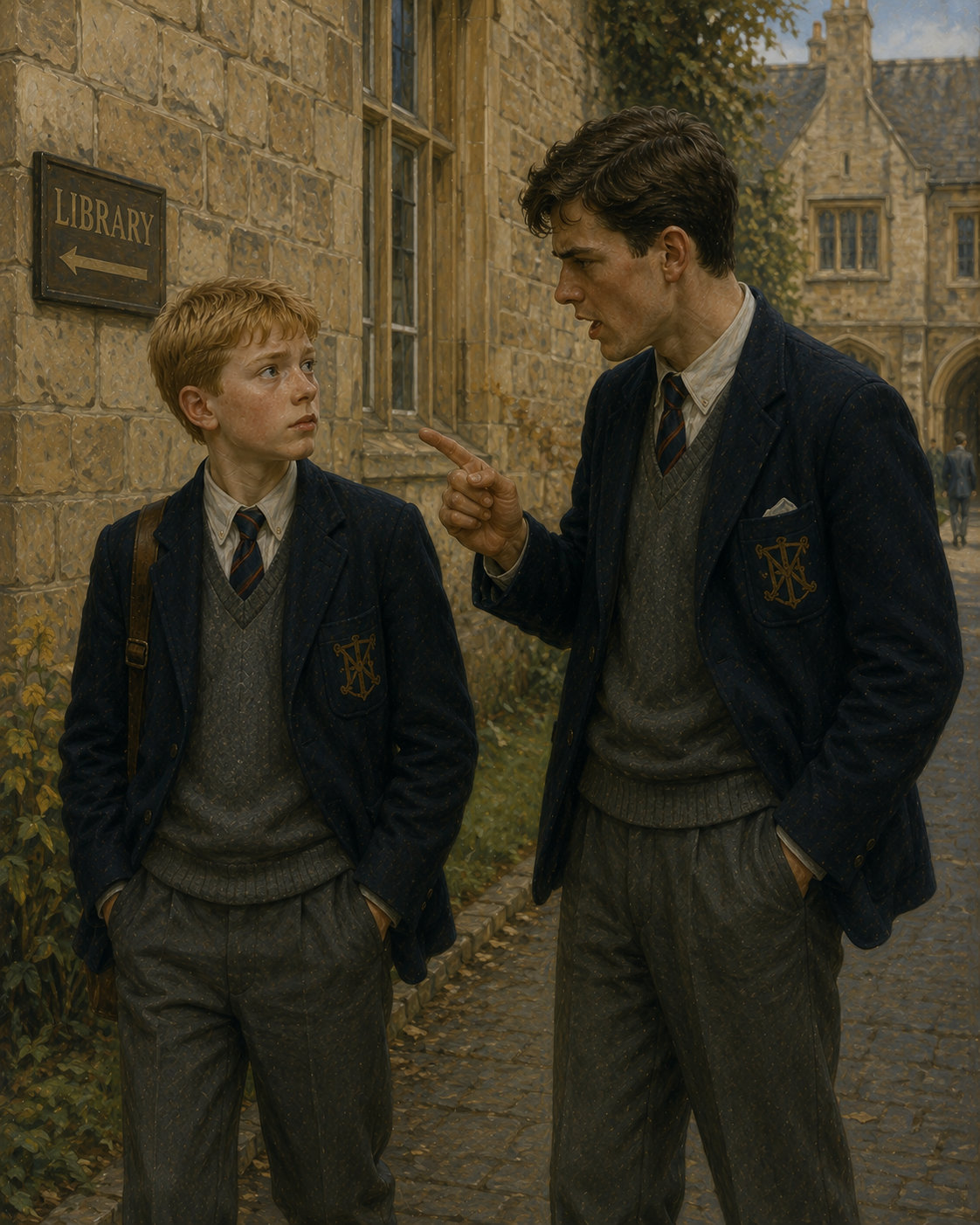
Unfortunately for me, games played a large part in the life of the school, as I discovered on my second afternoon. Following the afternoon lessons, nothing was on my timetable until dinner; I therefore made my way to the Library. En route, I encountered a senior boy who enquired where I was going. I told him, in all innocence, and was greatly astonished at his reaction. He hit the side of my head – very painfully – and shouted “Cutting Clubs... new bug, cutting clubs. Get out there NOW”. And much more in the same vein. It seemed that all boys, including new ones, were expected to appear on the games field every afternoon except Wednesday and Saturday, on which matches were played. Each boy would be allocated to a 'Club' to which he would belong for that term and from which the best players would be selected to form the House or School teams.
What astonished me was the tone of moral outrage in which I was abused. But the attitude, officially tolerated if not encouraged, was that every boy, “except a few rotters”, liked playing football and other games, and every boy’s greatest desire was to be chosen to play in a team. Several of the younger masters, who were keen sportsmen, concurred in this attitude and this was to land me in a certain amount of hot water.
And so it was that I made my way to the games field, and was allocated, with some verbal abuse for my lateness, to a Club. We were expected to play the game of Rugby football. We had done this in a rather desultory way at St Mark’s, but the Headmaster there had kept it under control since one boy sustained two broken limbs, a leg and an arm, during the same practice game.
I have never seen any point in these ridiculous pastimes, and to my mind running about a muddy field, generally in wet and cold weather, trying to kick or hurl a ball into a goal, is pointless. What, however, is far worse is the importance which these nonsensical games acquire in the minds not only of boys but of supposedly grown men. But of course it is in reality tribal warfare, very thinly disguised. One’s town, one’s School or House, one’s Club, become one’s tribe, to be not only defended against the attacks of other tribes, but to attack other tribes first. There seems to me very little difference between the row of cups in the glass case in one’s House and the row of heads impaled upon spikes outside an African village.
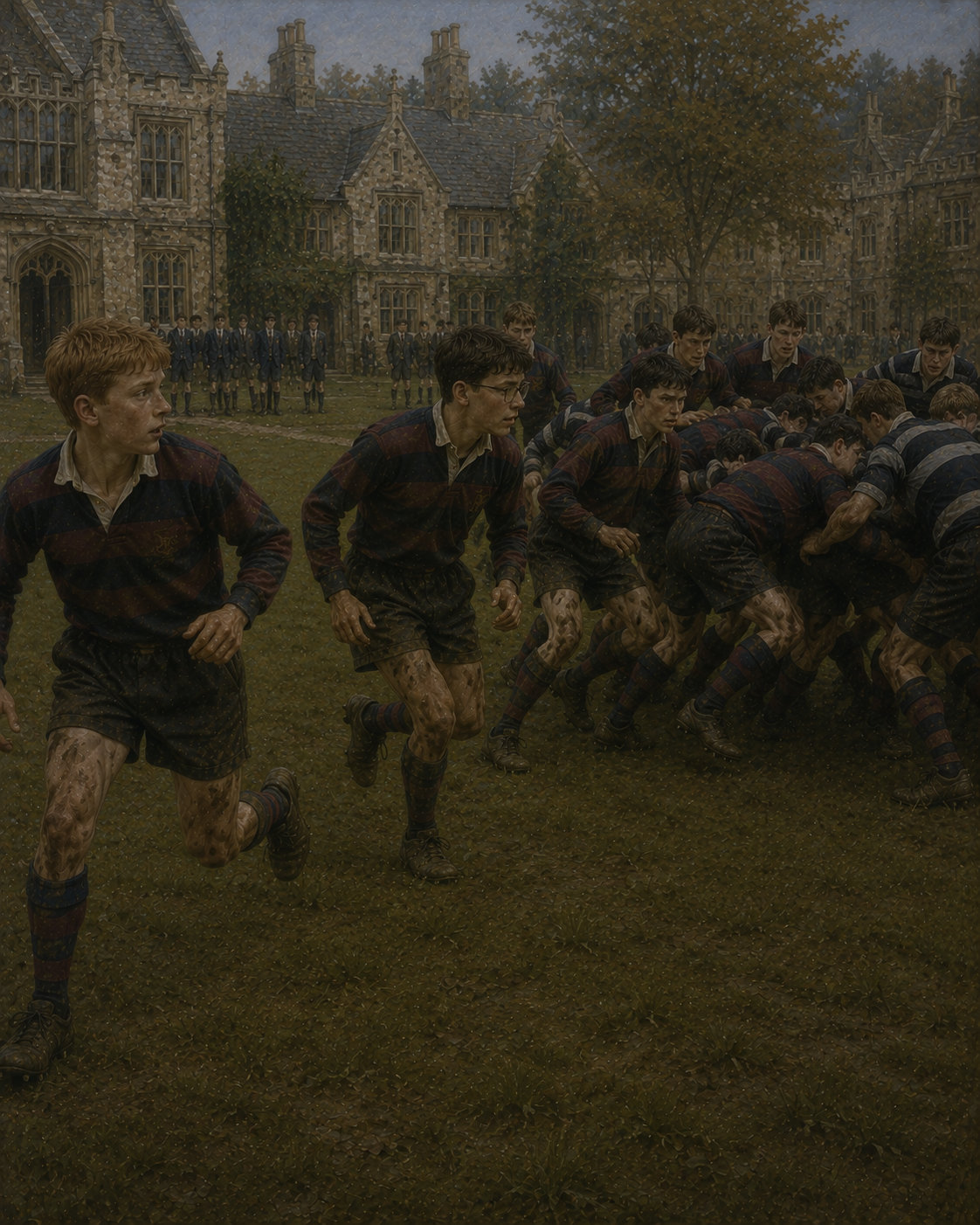
At Flamborough, during the winter terms, it was not unusual to see a boy with an arm in a sling, or a leg in plaster, and among the games-playing clique these were regarded as badges of honour. I managed to cope with games, as I had at St Mark’s, by turning up and putting up some semblance of interest, while keeping far enough from the scrimmage to avoid injury or annoyance. To my amusement, I began to notice certain other boys employing much the same tactics. One in particular was Gubbins, a lanky, bespectacled youth who regarded most things with amused contempt. Having been saddled with a silly name, rather than allow himself to be upset by the inevitable teasing, he cultivated an air of insouciance which allowed him to get away with a good many trivial misdemeanours. The masters knew that he would accept punishment in much the same spirit and generally dismissed his failings with a shrug of the shoulders. But he was fun to be with, was Gubbins, and his mild eccentricities won him more friends than enemies.
My schoolfellows were, on the whole, not a bad bunch. Webb, a light haired, tall boy had a superior manner and a sarcastic tongue which won him a couple of admirers, though most of us avoided him. His principal cronies were Bourne, an overweight, rather spotty boy who enjoyed lording it over smaller boys but was too cowardly to make his own mischief, and Ollier who liked to catch out others in verbal traps and then crow over their discomfiture.
On the credit side there were Holden, a Scholar like myself but on the scientific side; his passion was for Chemistry and he had, I was given to understand, a small laboratory of his own at home. My acquaintance with the Sciences was very limited, but I do remember his accumulating the materials for producing some exceptionally noisome smells. Also on the scientific side was Beadle, who very soon acquired the nickname “Bugs”. This was due to his passion for collecting and studying beetles, spiders and other creepy-crawlies. A walk with him was an education; he would always be looking out for any interesting creature and would whip out a powerful doublet lens from his pocket to inspect anything which caught his attention. But he was genuinely knowledgeable and after leaving London University gained an international reputation as an entomologist.
There were fewer boys in my year with an interest in classics or literature, though there were a couple who enjoyed languages; one in particular by the name of Bell took it into his head to learn Serbo-Croat. Since no-one else knew that language we had no way of gauging whether he was genuinely fluent or merely bluffing.
Over the next few weeks I found that there were one or two pretty juniors who could only be described as flirty. They attracted the attention of some senior boys and often led them a merry dance. What they got out of it I don’t know, unless it was some freedom from fagging. Possibly they just enjoyed doing it in a mischievous spirit. What was regarded as unacceptable was for a Flopsy in one house embarking upon a sexual relationship, however fleeting, with a boy in another house. But I refrained from joining in with any of these antics, until I was approached by a boy in the Lower Sixth, named Garbin. He was a Music Scholar, with a study to himself. He was, I believe, a very talented musician, who played the organ in Chapel on many occasions as well as playing first ‘cello in the school orchestra.
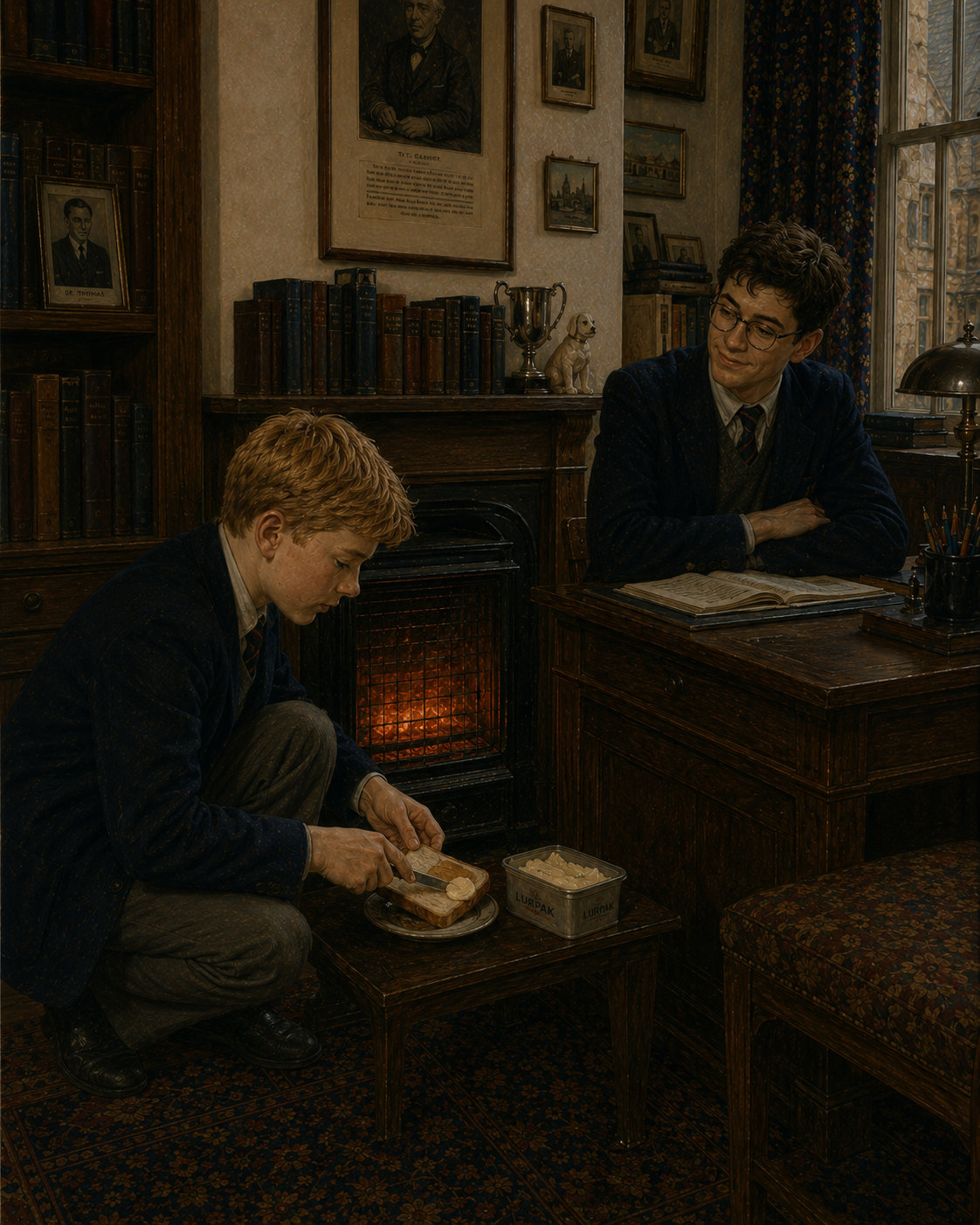
Garbin’s sexual requirements were undemanding and did not go beyond being fingered or fellated. In exchange for performing this simple act I was enabled to eat such delicacies as buttered toast, made in front of the electric fire in his study, and slices of fruit cake which I believe he got from home. The school food, though adequate, was both bland and monotonous, and the opportunity to supplement my diet with these tasty treats was well worth the small effort to keep Garbin happy. In addition, it was recognized that once a Flopsy was attached to one particular senior, he was untouchable by anyone else.
And I had the additional advantage, unrecognized at the time, that I was introduced to fine music. When he played the organ or piano Garbin liked me to turn the pages for him, and he was adept at explaining the construction of the music so that I began to take a real interest in it. I could not say that I loved Garbin, certainly not in the way in which I loved Allan, but we did certainly have a good deal of mutual affection, and I was genuinely sorry when he left to go to University.
As the weeks went by and I got to know my fellow Herveians, I discovered that there were not a few boys who despised games as heartily as I did, and introduced me into their groups with interests as varied as chess, music and even drama. Fortunately at Flamborough the academic standards were fairly high, and although each year group had at least one form filled mostly with games-obsessed dunces, there were others in which the majority of the masters would encourage not only formal learning of their subject, but original thought and initiative. So we wrote, and acted, short plays – most of them dreadful, but the occasional gem emerged – played musical instruments or sang, read and discussed poetry both in English and other languages, and even privately studied obscure languages, just for the fun of it. I had learned some basic Russian and in a rather desultory way studied some more. I came to know at least enough to read simple texts. A boy whose father was in the Diplomatic service occasionally brought a Russian newspaper or magazine to school and I was able to read most of it, by no means fluently but reasonably well with the aid of a dictionary.
And so the weeks went by. Allan and I wrote regularly to one another, and though our letters were careful not to mention anything which could be compromising if read by a third party, they were lively and filled with news of our various activities. It was also a pleasure to me to keep up with the news from St Mark’s, a place which I recalled with a very special affection. My mother was no correspondent and would anyway have taken no interest in my day-to-day activities.
The half-term exeat came and went – I returned to my parents’ house for the week – and the end of term came. I had managed to achieve a quite respectable place in the form orders in most subjects, coming top in Latin and second in English, and within the top five in all other subjects except mathematics. Unfortunately this was taught by Mr Harris, one of the games fanatics who took a dislike to me as one of the “rotters” who were not games-mad, and lost no opportunity of making me look ridiculous.
I spent the Christmas holiday at home. Two of the students who lodged with us remained there for the holiday as it was too far for them to return home. They were pleasant, lively youths and we enjoyed some stimulating conversation. One of them, Charles Power by name, who eventually became a consultant physician at one of the big London hospitals, was a great help to me. Hearing that I was struggling with mathematics at school, he had me bring out my books and spent several afternoons with me working through my holiday tasks and ensuring not only that I got the answers right but also that I understood the principles behind them.
Back at School for the Lent term, I continued with the round of lessons, avoiding games where possible, and other activities. I found myself liking, and enjoying making progress with, chess. I was surprised to find how many boys specializing in languages or Classics were competent Chess players; I had supposed that it was more likely to appeal to the mathematicians and scientists, but there were relatively few of these. At any rate, though I was never an exceptional player, I became good enough to be occasionally asked to take part in a match against another school.
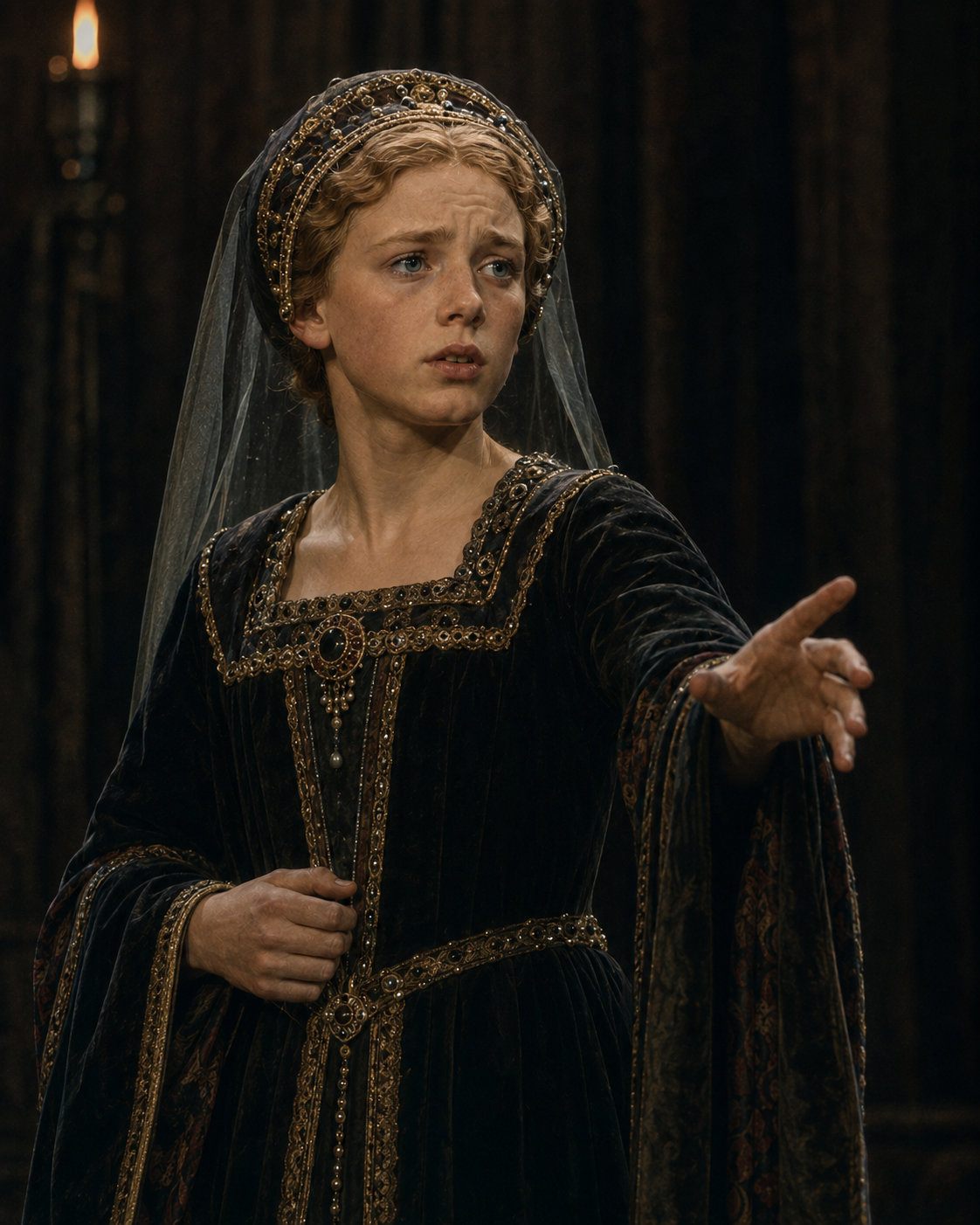
The School Play always took place during the Lent Term. It was a tradition that it was always a Shakespeare production, and this year’s was Macbeth. The women’s parts were always recruited from the Third Form, and after an audition I was given the part of Lady Macbeth. Fortunately, my reading of poetry had helped an already fairly reliable memory, and I was able to learn my part with no great difficulty. Three performances were given, a Friday evening, a Saturday matinee and the Saturday evening. I was one of only three boys whose parents did not attend; the parents of the other two lived abroad.
Wearing a woman’s costume, albeit a twentieth-century idea of what Elizabethan costume was like, had a curious effect upon me. I cannot deny that it titillated me, if mildly, and after the last performance Garbin and I had probably the most enjoyable and intense sex I ever remember with him. But I have never, since then, worn female clothing and have never felt that I wished to do so.
My involvement in this production, and further plays in which I took parts, gave me a taste for drama which has never faded. Even now I seldom miss a new London production and I was also to become involved in dramatic productions at University.
I had arranged with Allan that I should visit him in Penzance during the Easter holiday, but about two weeks before the end of term had a letter from him saying that his Mother was very unwell and we had better postpone our meeting until the Summer holiday. This was a grievous disappointment to me, but clearly there was nothing I could do about it. I wrote back to Allan asking him to remember me to Mrs Pascoe and giving her my love and best wishes for her recovery.
So once again the Easter holiday was spent at home with my parents. Charles, the student who had helped me with my mathematics before, was still there and still happy to give me some informal tutoring in the subject. Unfortunately, Simon Walker, who clearly had a taste for young boys, was also back in residence and had an annoying habit of letting his hand brush against my leg or arm as if by accident. However, it was easy enough to keep clear of him except at meal times, and since I was becoming a proficient cook I was generally in the kitchen at times when he was about.
I kept up my visits to the British Museum. London is wonderfully blessed with its wealth of fine museums – all of them free to enter – and I took full advantage of them. On one occasion I was in the British Museum – not for the first time I was looking at the wonderful cartonnage of Artemidorus – when I found that I needed to pee. I went down to the jakes in the basement and stood at the urinal, when I became aware of a middle-aged man standing a couple of spaces away from me, clearly eyeing me sideways and slowly manipulating an erection. Not surprisingly, my own penis sprang to attention, and we both stood a little away from the urinal so as to give each other a good view. Although I was getting better control – I have to say that Garbin must take some of the credit for this, as he liked to make it last – I climaxed quite suddenly, whereupon the man watching me clearly could hold back no longer and produced several spurts of impressive volume – so much so, indeed, that at first I thought he was urinating, until I saw the white semen on the floor tiles at his feet. I never encountered this man again, and never got into the habit of “cottaging”, as the practice of meeting men in public lavatories for sexual purposes is nicknamed.
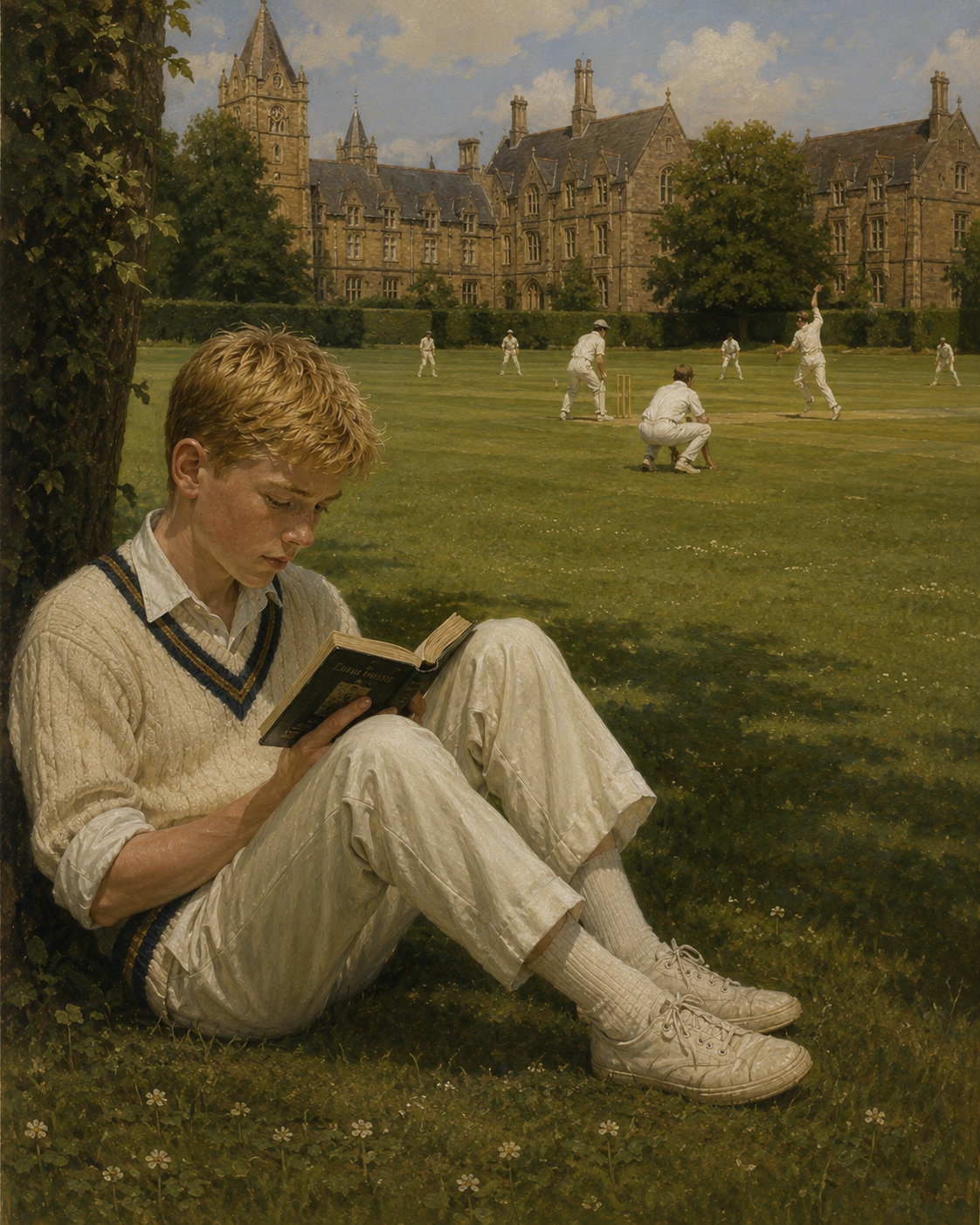
The Summer term was in some ways more relaxed than the Michaelmas and Lent terms. We were, of course, preparing for end-of-year examinations, and the warmer weather and light evenings encouraged more outdoor activities, but at least the constant pother of football was finished with; cricket, a more civilized and less hazardous game, took its place. Not that there were not many boys as fanatical about this as there were about football, but they did not display the naked aggressiveness of the footballers. The advantage of cricket for me was that if I were on the batting team I could spend most – or with luck, all – of the half sitting quietly with a book. Fielding, of course, was tedious in the extreme, though I could often lose myself in a train of thought. This got me into trouble once or twice when I missed an “easy catch”.
Half-way through the term, I received a letter from Allan.
“My dear Thomas,” he wrote:
“It is with very great sadness that I have to tell you that my Mother died last week. She spoke of you often and asked me to send you her love. She had struggled with illness for some months, but in the end there was nothing more that could be done, and she passed away peacefully in her sleep.
“The house in Penzance will be inherited by my older brother, who is intending to live there. I am glad that it will remain in the family. However, my Mother left me a sum of money and I have decided to buy a house fairly near to St Mark’s which I can use during holidays. I am sure I do not need to tell you that you will be welcome there at any time, and I hope that you will come to look on it as a second home. I am hoping that the formalities will be concluded before the end of the Summer holidays so that you can visit me there.
“With every good wish,
“Yours truly,
“Allan.”
* * *
I confess that when I read this letter, I wept bitterly. Although I had only met Mrs Pascoe on two visits to Penzance, she had become very much a mother figure to me, as Allan had become, if not a father figure, at least a loving elder brother. And I would be very sad not to be going to Penzance again, or indeed visiting Porthcurno beach with Allan. On the other hand, he was buying a house which was within a reasonable distance of Flamborough – probably no more than forty miles or so by road – and it could be possible that I should be able to visit him more frequently.
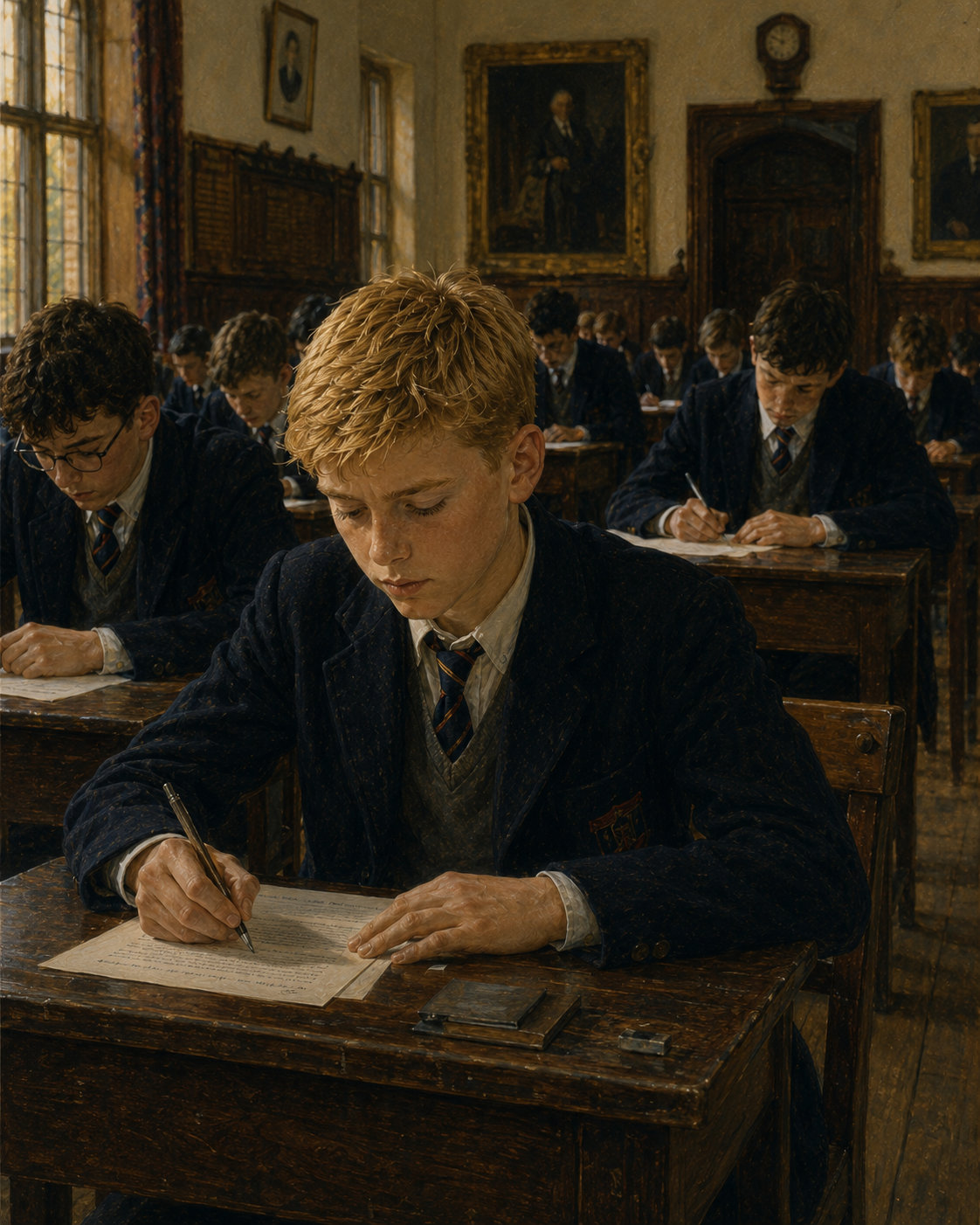
The end of year examinations took place, and again I made quite a reasonable showing, coming top in Latin and near the top in most other subjects. In Mathematics I did considerably better than I had expected, due not to the teaching of Mr Harris, for that was largely confined to carping criticism, but to the help given to me by Charles Power, the student who lodged with my parents. Mr Harris did, indeed, give me some grudging praise, though he never got over his dislike of me due to my noncurant attitude to football.
Fortunately, for the remainder of my time at Flamborough I was taught mathematics first by Mr Willis, a gentle, elderly man nearing retirement, and lastly by Dr Godfrey, who took the Classical Sixth and delighted not only in demonstrating that the discoveries of the great mathematicians and geometers of the Greek and Roman worlds were as true today as when first made, but also explored with us the contribution of the mathematicians of the Arabic world. I was beyond measure thrilled to discover that the Persian poet Omar Khayyam, whose Rubaiyat, in Edward Fitzgerald’s elegant translation, had long been a favourite work of mine, was also known as a mathematician and astronomer.
Comments powered by CComment