
STORY OF THE MURDER OF ‘ALI ‘ADIL SHAH I., FIFTH KING OF BIJAPUR,
AS TOLD BY CONTEMPORARY HISTORIANS.
BY CAPTAIN J. S. KING, Bo.S.C.
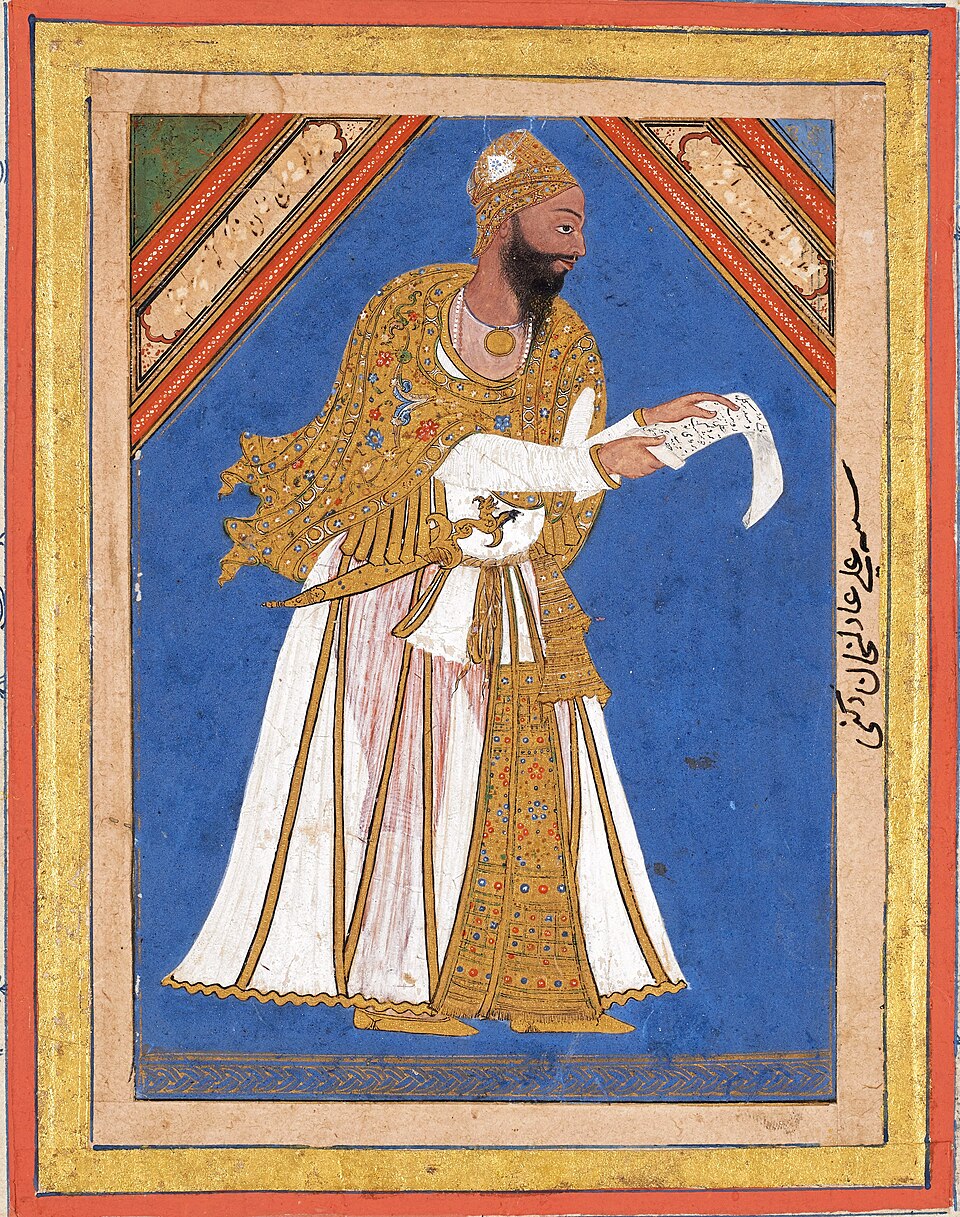
Ali Adil Shah I (ca. 1540-80) was the Moslem ruler of the powerful state of Bijapur in southern India from 1558. The accounts of his murder written in the thirty years after his death conflict in their account of it, though all but one say his eunuch assassin was a beautiful boy desired by him. They were assembled together by James Stewart King (1848-1910), an officer in the British Indian army and an oriental scholar specialising in Persian historical manuscripts relating to the Deccan, in the article presented here, published in The Indian Antiquary, vol. XVII, Bombay, 1888, pp. 221–224. The illustrations have been added by this website.
No detailed account of the death of ‘Ali ‘Adil Shah I. has yet been published in English. In the Bijapur volume of the Bombay Gazetteer[1] this event is disposed of in the following words:—“In 1580 ‘Ali was assassinated in a brawl with one of his servants.”
Farishta[2] gives the following account of it:—“In the year 987 (A.D. 1579-80), as the king had no son, he appointed his nephew Ibrahim, son of his brother Shah Tahmasp, his successor, and the following year he was assassinated by a eunuch, whom he had forced against his inclination to come to his Court from Ahmadabad Bidar.”
Briggs,[3] in a note on this passage, says:—“A more detailed account of this transaction is given by Farishta in the History of the Kings of Bidar. He evidently avoids the subject in this place, in order not to give offence to Ibrahim ‘Adil Shah II., the nephew of ‘Ali ‘Adil Shah, under whose patronage he wrote. The cause of the king’s death is most disgusting and offensive, and it is by no means attempted to be palliated by Farishta when he mentions it. A modern author of the history of Bijapur, however, has set forth reasons in defence of ‘Ali ‘Adil Shah’s conduct, and endeavours to prove that Farishta has traduced his memory.”
Farishta’s “more detailed account” above referred to, is thus translated by Briggs[4]:—
“In the year 987 (A.D. 1579), Murtaza Nizam Shah made an attack upon the remaining part of the Bidar territories, and laid close siege to the capital itself. ‘Ali Barid, thus straitened, sent an envoy to ‘Ali ‘Adil Shah, who replied that if he would make him a present of two eunuchs, whom he named, he would send him assistance. ‘Ali Barid assented; and two thousand Bijapur Cavalry marched to raise the siege of Muhammadabad Bidar.[5]
“Murtaza Nizam Shah, hearing of the approach of the ‘Adil Shahis, and also of the rebellion of his brother, Burhan Nizam Shah, at Ahmadnagar, retreated to his capital, and left Mirza Yadgar with a body of Qutb Shahis, who had joined from Gulkunda, to prosecute the siege; but as soon as the Bijapur detachment arrived within a few miles of the place, Mirza Yadgar retreated, and ‘Ali Barid delivered over the two eunuchs, contrary to their own inclination, to the Bijapuris. These two youths were so stung with shame on being transferred from one king to another, that shortly after their arrival at Bijapur, one of them put ‘Ali ‘Adil Shah to death, as we have before seen in this history.”
Khafi Khan, who enjoys the reputation of being the most impartial of Indian historians, gives the following account of the murder of ‘Ali ‘Adil Shah[6]:—
“In the year 987 (A.D. 1579-80) he nominated his nephew, Muhammad Ibrahim, son of his brother, Shah Tahmasp, as his successor, and gave him full power, whilst he gave himself up to sensual enjoyments.
“When it came to his ears that ‘Ali Barid had two handsome eunuchs, one of whom in beauty, and the other in delicacy, was a reproach to the sun and the moon, he conceived an intense longing to become possessed of them, and, accordingly, sent a message (to ‘Ali Barid) asking for them. ‘Ali Barid at first was firm in refusing; but afterwards, on account of his excessive entreaty, he sent them both to ‘Ali ‘Adil Shah. Each of these eunuchs knew why he had been sent for; and the elder one, who had a hankering after evil, concealed a knife in the waist-band of his drawers, and awaited the opportunity for the infliction of punishment.
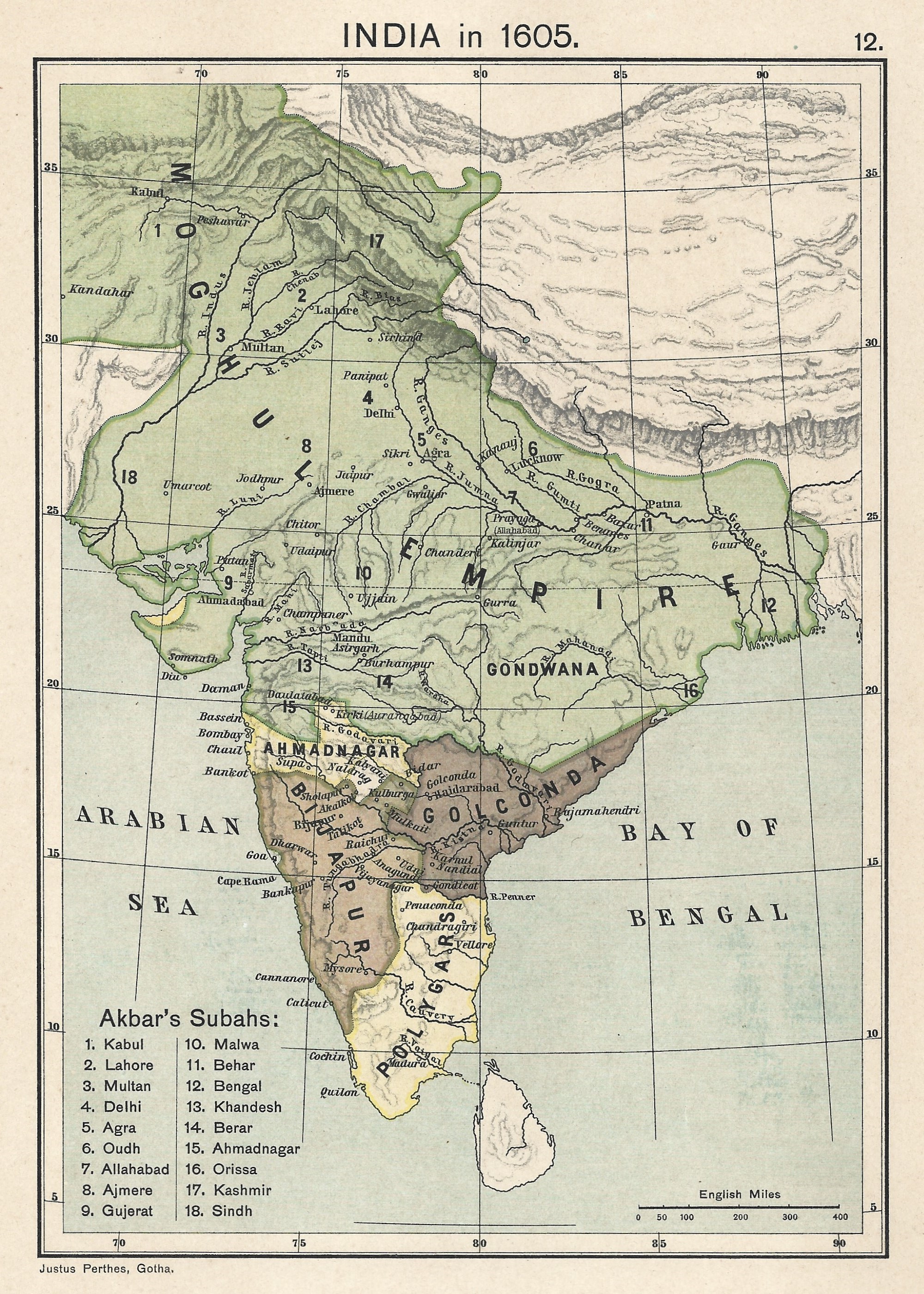
“At last, one night, ‘Ali ‘Adil Shah summoned him into his private apartment, and endeavoured to lie with him. The eunuch, on getting the opportunity, plunged that knife into his hypochondria with such force as to put a stop to all sensual desire; and in the year 988 (A.D. 1580) ‘Ali ‘Adil Shah hurried from this world to his permanent abode; and, in retribution for the crime of one, the two eunuchs were put to death.”
The next account of this occurrence I extract from a very rare Persian MS. history of the ‘Adil Shahi dynasty of Bijapur, entitled Basatinu’s-Salatin, by Muhammad Ibrahim az-Zubairi, completed, as the author himself informs us, in A. H. 1240 (A.D. 1821). General Briggs published his translation of Farishta in 1829. From these dates, and from the fact that the copy of this MS. now in the Royal Asiatic Society’s Library belonged to General Briggs, I conclude that this is the history to which he alludes in his footnote already quoted; but before making any further remark on the subject, I shall proceed to translate the passage:—
“‘Ali ‘Adil Shah’s twin sister (ham-shira), named Tanibai Sultan, had been married to Ali Barid; and having died without issue, her movable property, consisting of valuable jewellery and other goods, remained in ‘Ali Barid’s house; and as by Muhammadan law it was allowable for ‘Ali ‘Adil Shah to demand restitution of these, he at once sent a messenger to ask for them. ‘Ali Barid returned all the effects except the jewellery, the claim for which still remained unsettled, till, in the year 988 (A.D. 1580), Kamil Khan renewed it, and petitioned ‘Adil Shah, saying:—‘There is an old-standing connection between me and Barid; with your permission I will send a person on my account and recover the goods.’ ‘Adil Shah replied:—‘I have a large claim against him, and can claim it by law.’ Kamil Khan, considering this as equivalent to permission, brought General ‘Ali Aqa into the presence of the king, and after giving him the necessary instructions, despatched him to Bidar.
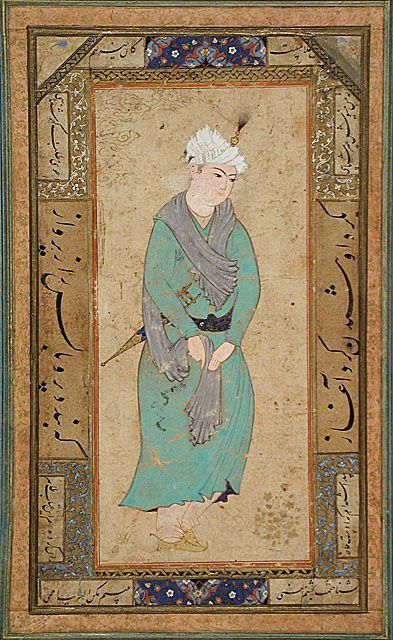
“‘Ali Aqa returned after four months, and presented to the king a portion of the jewellery, together with two eunuch slaves who had formerly been in the service of ‘Ali ‘Adil Shah’s twin sister, above mentioned.
“One night ‘Adil Shah summoned to his private apartments one of those eunuchs, who was more intelligent than the other, in order that he might make inquiries about his sister’s jewellery. This eunuch was of an evil disposition, for as soon as he came into the presence of the king, although there were two or three servants standing by, he plunged a dagger up to the hilt in the king’s breast, so that it came out at his back. The king, wounded as he was, arose from the chamber, and reached the court-yard, where he fell, and those who were near raised a clamour.”
Rafi’u’d-din Shirazi,[7] who held the appointments of Havaldar-i-Mahallat, Khan-Salar and Treasurer, says:—
“I was present outside the palace at that time, as also was Afzal Khan, who had been sitting there with some people transacting business. At that moment they had just got up to go to their houses; but he had not quite reached the gate of the fort when a shouting and clamour arose. On going inside I found the king lying bathed in blood. Afzal Khan came running back, and, after looking at the king and feeling his pulse, cried out:—‘Alas! Dust is on our heads!’ Then, raising the king, we laid him on a couch, and went outside. The murderer had remained in the private apartment, and some one wished to enter it and bring him to punishment, but he had fastened the door on himself. However, next day he received the punishment due, and the other eunuch was put to death by the slaves on the same day.
“The people of the city, hearing of the death of the king, rushed in crowds to the gate of the fort that night. The nobles, grandees and amirs also, both superior and inferior, assembled at the gate, but did not obtain admission.
“After morning prayers, some one came to the gate and cried out:—‘All the Ministers and nobles are assembled at the gate, and, with compliments, send this message to the prime minister, Afzal Khan:—We have passed the whole night here, like fish without water, in disquietude and anxiety, and we are all anxious to know from you what arrangements have been made for carrying on the government.’ Afzal Khan replied:—‘I await the good pleasure of my colleagues; whatever they advise, and whomsoever they may confirm in the sovereignty, they are free to do as they please.’ The nobles, on hearing this, held council, and confirmed with oaths the promises as to the hereditary succession. They then sent Mir Murtaza Khan Anju, who went near the gate, and proclaimed the decision of the council, saying:—‘Shah Kamalu’d-din Fathu’llah, being vakil on your part, with the approval of all the nobles has agreed that we shall confirm in the sovereignty the king’s nephew, Prince Ibrahim, who is the rightful heir, and whom the king during his lifetime appointed and educated as such. Also that you shall be Prime Minister, as formerly; and the other offices be filled by whomsoever you may please.’ Afzal Khan replied:—‘I cannot undertake this important affair; appoint some one else.’ Murtaza Khan said:—‘At all events, you and the nobles can assemble in council, and whatever you determine upon will be confirmed.’ Afzal Khan said:—‘A great crowd is assembled here, and if we open the gate there will be a rush of the common people, and perhaps a disturbance may arise. The best plan is for you with only three or four selected persons to come inside.’
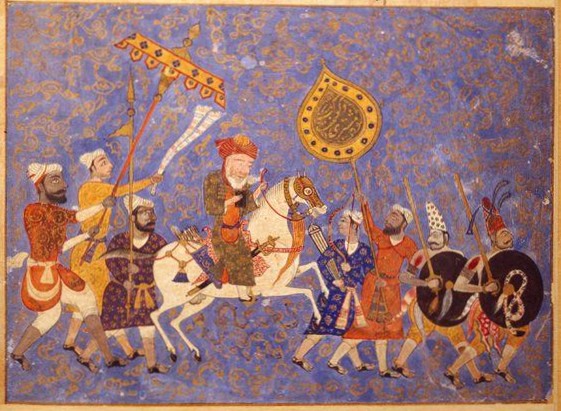
Jupiter as an Old Man with Attendants, folio 37v of the Nujūm al-ʿUlūm, a manuscript produced in Bijapur in 1570 and apparently composed by Ali 'Adil Shah himself, so authoritative as to contemporary customs and dress
“Then Shah Kamalu’d-din Fathu’llah, Kamal Khan, Murtaza Khan and Manjan Khan, youngest son of Kishwar Khan, and son-in-law of Kamal Khan, went inside, and, after taking counsel together, went to the door of the haram, and, bringing forth Ibrahim ‘Adil Shah, took him to the summit of a tower; and, seating him with much more ceremony, raised over his head the gold-embroidered umbrella.”
According to Mirza Rafi’u’d-din Shirazi, author of the Tazkiratu’l-Muluk (who was an eye-witness of the occurrence), ‘Ali ‘Adil Shah I. was murdered on Monday, the 24th of the month Safar, A. H. 988, at the eighth hour of the night, which corresponds to 2 a.m. on the 19th March 1580.
The above detailed account of what followed immediately after the murder is interesting, and probably true in every particular; but in relating the circumstances which led to the murder, Rafi’u’d-din seems to me to have failed to remove the stigma cast on the memory of ‘Ali ‘Adil Shah I. by Farishta and Khafi Khan.
[1] Vol. XXIII. p. 119. [Author’s note]
[2] Briggs, ed. Vol. III. p. 142 n. [Author’s note]
[3] Vol. III. p. 142 n. [Author’s note]
[4] Vol. III. p. 198. [Author’s note]
[5] So in Briggs’ text, but the more usual appellation is Ahmadabad Bidar, as above. [Author’s note]
[6] Muntakhabu’l Lubab. [Author’s note]
[7] Tazkiratu’l-Muluk. [Author’s note]
Comments powered by CComment