
THE AUTOBIOGRAPHY OF A SCHOOLBOY
A MEMOIR BY THOMAS TOMKINS, V
Presented here with his kind permission is Chapter Five of the hitherto unpublished memoir of his youth of a retired English publisher written under the pen name Thomas Tomkins and finished in 2026.
[Return to the beginning of this memoir]
Chapter Five
The following September, I returned to school for my Scholarship Year. I knew that my parents were not well off, and that if I were to be able to go to even a modest Public School I should have to earn a full Scholarship. Given my mother’s snobbish attitudes, it was inevitable that I could not contemplate going to a State school with “common” children, and so I set to work with some energy. I was in the Scholarship Form, which had the advantage that my companions were all Scholarship candidates, and the competition between us helped us to achieve high standards. The work was demanding, but on the whole interesting, and I had the advantage that Scholars in their final year were not expected to take much interest in Games, unless they wished to.
But in October came a devastating blow. I was summoned on a Friday morning by the Headmaster, and I knocked on his study door, wondering, with some trepidation, which of my various misdemeanours had come to his notice. However, he invited me to sit down and looked at me kindly, but with an air of some discomfiture.
“I have to tell you,” he said, “that your father has met with misfortune. This will not affect your remaining time here as your existing Scholarship will cover all eventualities, but it will mean that you and your parents will need to look carefully to your future.”
“What has happened to my father?” I asked.
“I don’t know the details“ he replied, “but you will have to go home for the weekend to see your parents. Go back to your lessons now, and don’t worry.”
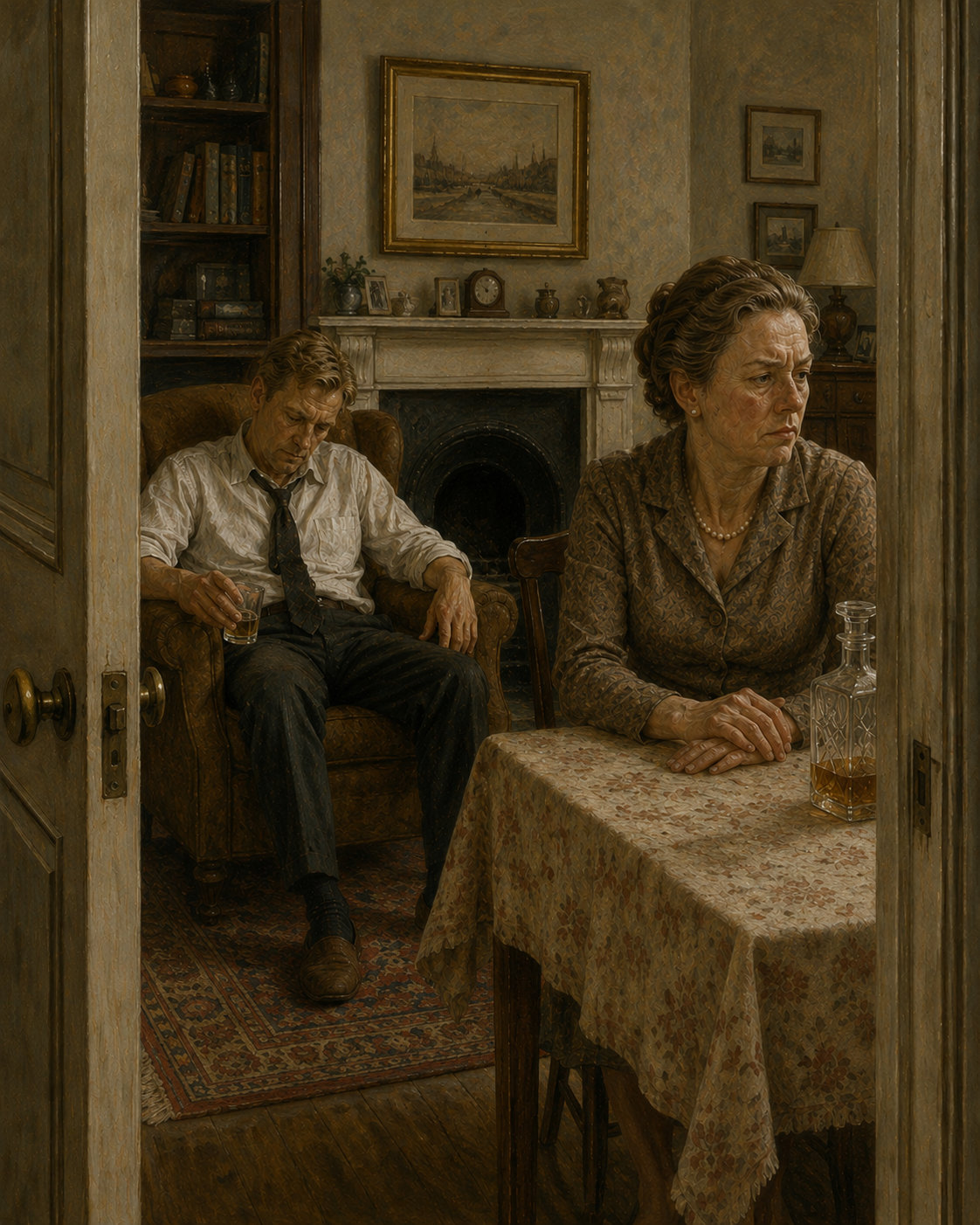
So the following morning I was put in a car driven by Slocombe, the school groundsman, and taken home. I arrived at lunchtime, but there was no sign of a meal. My father was slumped in a chair, clearly much the worse for drink. My mother sat at the table, pale, trembling and obviously furiously angry. She was only too ready to tell me about what had happened. It seemed that my father had been accused of “interfering with” a woman patient, and would have to attend a hearing at the General Medical Council in London before he was permitted to resume practice.
That was all I was told, and indeed all I was ever told, except that the woman concerned had accused him of grabbing her breasts. But, putting two and two together, I realized what had happened. Whatever his faults, my father was no womanizer and no adulterer, but he had probably been drinking all day and when it came to his evening surgery, he had been intoxicated. Whether he stumbled and grabbed at his patient, or was just not aware of what he was doing is neither here nor there, but the G. M. C. would have the power to determine whether he could be allowed to resume practice or not.
That weekend was the longest and bleakest of my life so far, and I wanted nothing but to get back to St Mark’s, to my friends and the comforting routine of study and activities with my friends. My father drove me over there on the Monday morning – I am glad we go there safely as he had probably already taken some whiskey – and dropped me silently at the school door. There I was met by Mrs Halford, the Headmaster’s wife, who asked with some concern how I was, and took me with her to the Headmaster’s study.
The Gaffer was, as I have said, a rather dry old stick, but on this occasion I found both him and his wife sympathetic. Inevitably, I was still in a state of emotional turmoil, and longed for lessons and the return of routine, at least the semblance of normality. I remember asking Mrs Halford whether any of my friends knew anything of what had happened, and she reassured me that they did not, only that there had been “family problems”. I found out later that all of my school year had been kept behind after Chapel and firmly told not to pester me with questions.
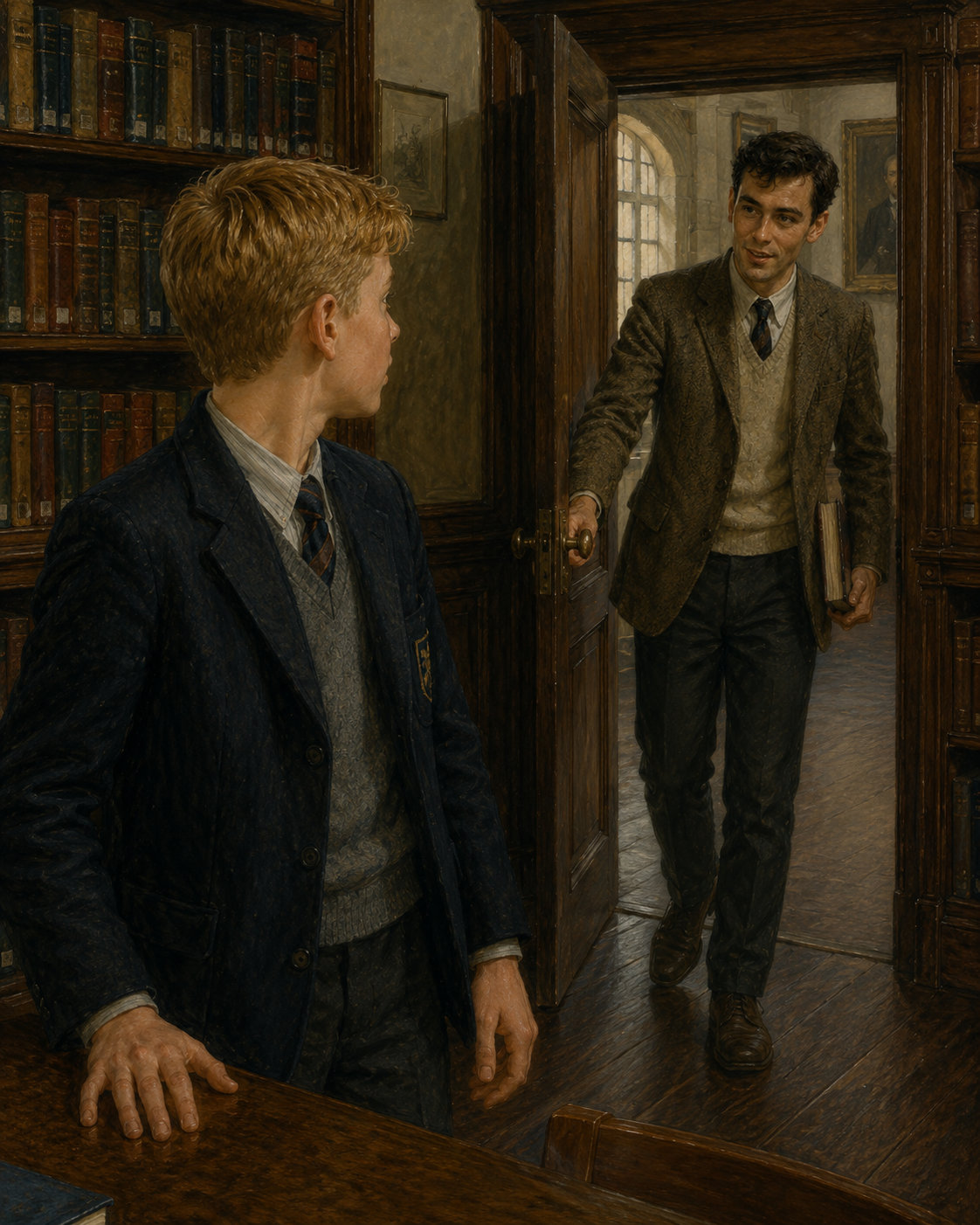
The Gaffer told me to go to the Library for as long as I wanted to, and then return to lessons. I wandered around the room for a few minutes, unable to settle, my mind in confusion, when the door opened and Mr Pascoe came in.
“Ah,” he said, “I thought I might find you here. The Headmaster told me what has happened, but no-one else knows anything. “
At that point I am not ashamed to say that I clasped him as a drowning man clasps a rock. I was too much upset to weep – that would come later – but he held me in his arms without speaking. His warm, friendly embrace reassured me that if all else failed, here was one person I might depend upon. To this day, the smell and feel of a tweed jacket is something which I find reassuring. I have three Harris tweed jackets in my wardrobe and would not part with them for anything the world has to offer.
As it happened, the next lesson on my timetable was Latin, and we walked into Mr Pascoe’s form room together. Mindful of the injunction not to question me, the other boys gave no more than a nod of greeting, and the lesson proceeded.
* * *
A week later came the half-term exeat which I spent with Granny T. The G. M. C. hearing came during that week, and I was told that my father had been ‘struck off’ the register of medical practitioners, and was, effectively, not only unemployed but unemployable, at least as a medical practitioner of any kind. I had by then become familiar enough with his weakness to realise what the result would be upon him. But I had no idea what my mother would do.
I have to say in my mother’s favour that she took her wedding vows seriously and, while no-one, least of all myself, would have blamed her if she had left my father, she stuck loyally by him until his death. But the immediate question was that of money: what could they do for an income? The problem was solved by selling the house and the practice and moving to a tall, narrow house in the Bloomsbury district where they let rooms to lodgers. In this they chose their location wisely as there were always students at the University in need of accommodation and during the summer holiday even the occasional foreign visitor at a Summer School.
I went to that house for the first time for the Christmas holiday, and found it bleak and uninviting. It was one of those high, narrow Victorian houses most of which have now been divided up into small flats, but which had originally been designed for large families with fatigue-proof servants. Much of the interior decor was pre-war and, although reasonably clean, was rather shabby and worn. My mother and father had separate bedrooms on the second floor. The ground floor provided a large sitting room and dining room, plus kitchens and a tiny room on the half-landing which did duty as an office. There were four bedrooms on the first floor, a bathroom on the half-landing, two more bedrooms and a further bathroom on the second floor and three servants' rooms under the roof. Impoverished students would occupy these, but one was, for the time being, reserved for me. Perhaps the worst thing about that house was the impossibility of heating it. In the winter, roaring fires were kept up in the sitting room and dining room, but the bedrooms were uniformly cold and draughty. The first floor bedrooms had gas fires installed in the grates, but the occupants of the attic rooms were provided only with small electric radiators.
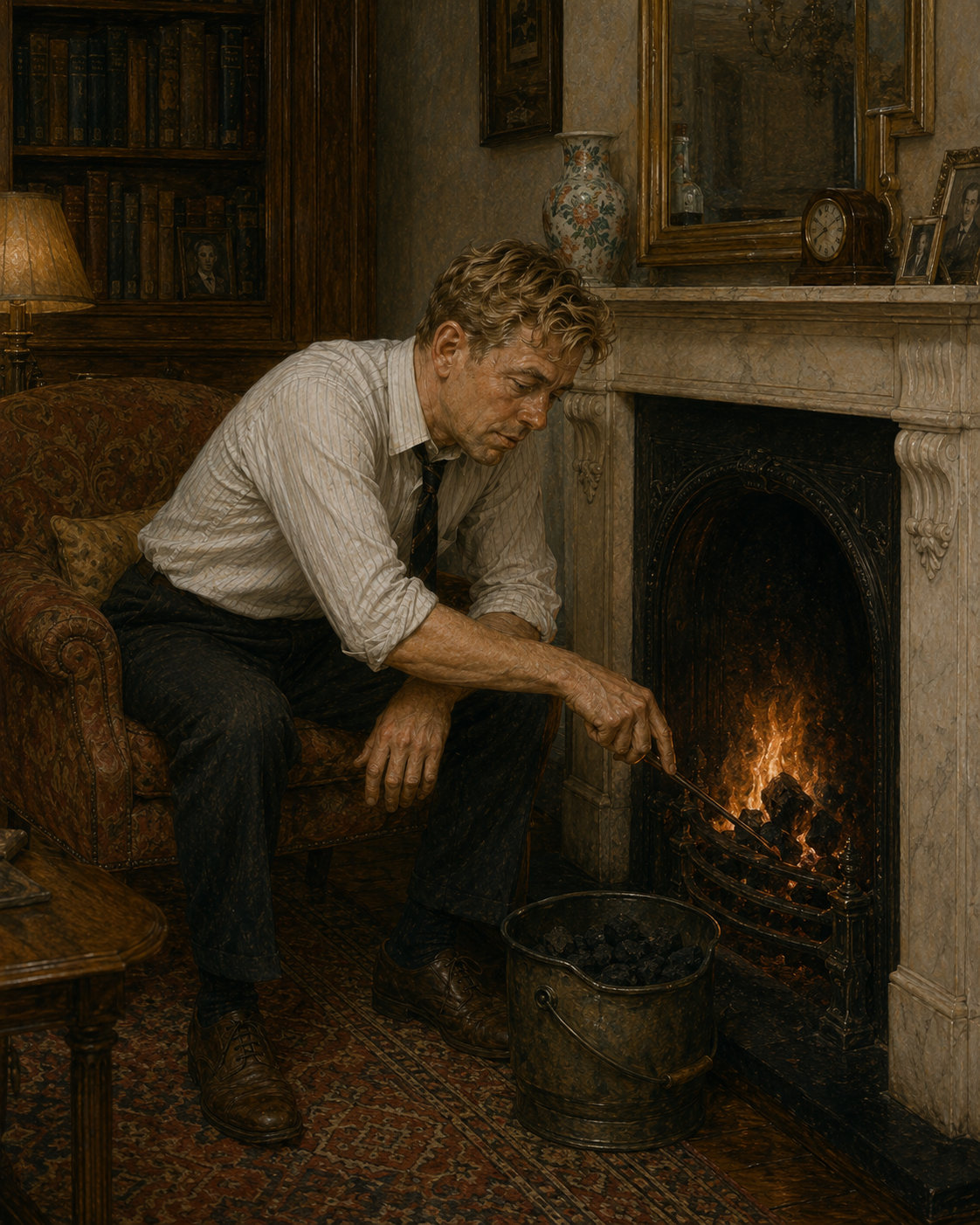
My father spent most of his time sitting in a chair and staring vacantly into space or, when prodded into it by my mother, fetching and carrying, looking to the fires and so forth. She did her best to keep him sober, but he managed not only to bring bottles of whiskey into the house undetected, but to conceal them in places only he knew. I believe this is not uncommon with confirmed alcoholics who display considerable wiliness in maintaining their supplies of spirits.
Curiously, now that the worst had happened, my mother actually became more approachable and even kindly. She would say things like “I know your father has let us all down, but it’s not your fault.” However, that Christmas, with its dinner in the cold, dingy dining room, was not one I enjoyed, and I was not sorry to return to school.
The Lent Term, which began in January, was traditionally the least interesting and the one in which the most work was done. Again, I set to with a will. Mr Cubber, Mr Swithinbank and Mr Pascoe were constant reassuring presences in the background, and my friends, uninterested in domestic matters, kept me occupied with our activities. I remember that a favourite pastime of many of us in that term was the construction of aircraft made from Balsa wood and powered by a rubber band.
An unusual feature of St Mark’s teaching was “Quiz Time” – an occasional lesson in which, supervised by a master, boys would ask one another questions about whatever subject the master in charge of the lesson taught. This was a curiously efficient method of learning; I have since heard it said that the quickest way to learn something is to teach it. At any rate, I enjoyed these sessions – I think we all did – and gained much benefit from them. My parents’ troubles faded into the background, and my academic progress was cautiously commended by the masters.
Then came the half-term exeat. My mother had written to the school, explaining that as all of the rooms in their house were occupied by – I have no doubt that she used the genteel term ‘paying guests’ – could they please arrange for me to spend the half term at school or with another boy.
The Headmaster was in something of a quandary here, as it was no part of his duty to arrange accommodation out of school time for his pupils. He did, I believe, approach one or two parents, who no doubt replied with courteous excuses. In the end, he put the problem to his staff, and the result was that I was farmed out to Mr Pascoe. Looking back on it, I am certain that he volunteered for this, no doubt with a proper diffidence but with little prospect of his offer being turned down. Mr Pascoe had a room in the School House which he occupied in the term time, but his holidays were spent at his mother’s cottage in Cornwall. He had no car, so we travelled by train, first to Liverpool Street Station, then across London by Tube[1], then from Paddington on the long journey down to Penzance.
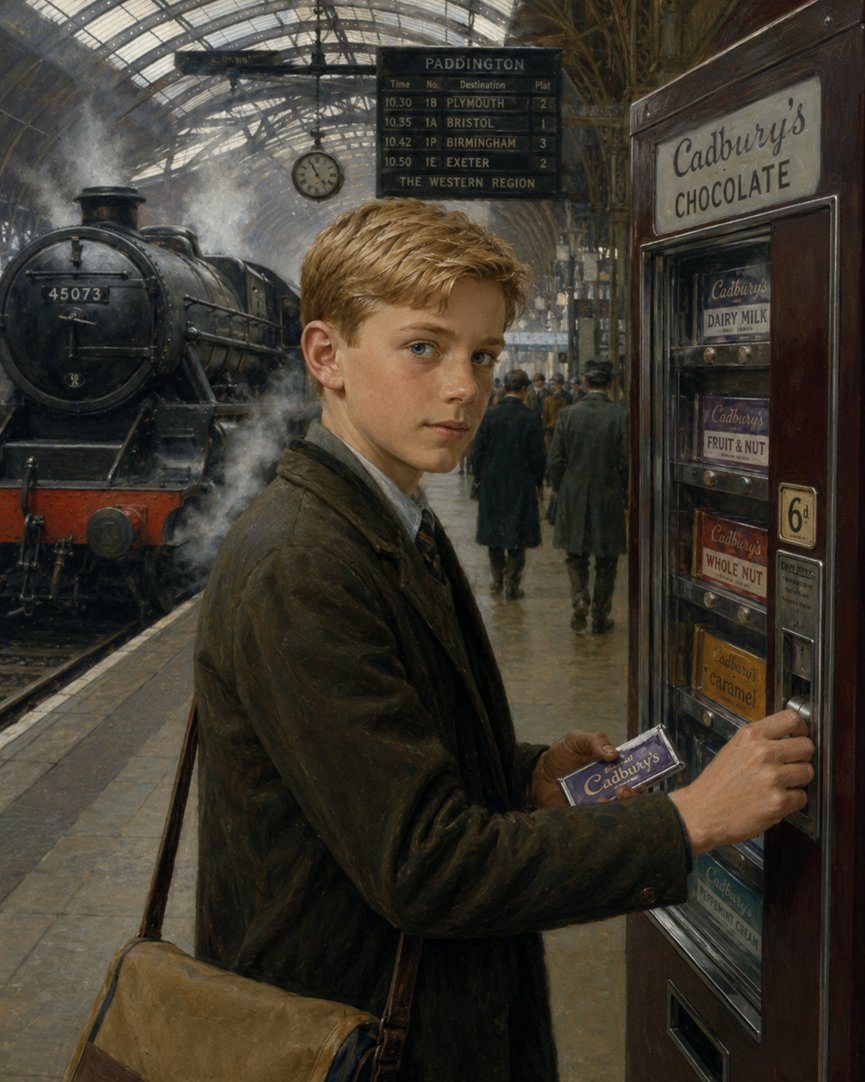
I had travelled very little by train until then, and was delighted to see the locomotive – in those days, some longer journeys were still hauled by steam locomotives – and to explore the stations, especially Paddington, a place of endless interest to a boy. The station was well provided with automatic machines and I had no hesitation in using them to equip myself with one or two sticks of chocolate. The journey itself was quiet enough. I and Mr Pascoe had provided ourselves – inevitably! – with books, and sandwiches which I suspect Mrs Halford had made. It took most of the day to get there, and when we arrived at Penzance it was to find a chill, drizzly rain. Fortunately Mrs Pascoe’s house was within a few minutes’ brisk walk of the station, and I was delighted to find it in a street of mostly quite modest houses, with small windows and a look of cosiness about them.
And cosy is a very apt description of the interior. The rooms were small and low-ceilinged, but there was a bright fire burning in the hearth, brass and copper ornaments reflecting the firelight, an inviting smell of baking and a feel of real welcome.
And nothing could have been warmer than the welcome given to me by Mrs Pascoe. She was a small, plump woman with white hair framing a pink and white dumpling of a face. She was clearly as proud of her son as anyone could be; she never tired of telling me, in her delightful soft Cornish burr, how hard he had worked at school, how he had got to the University and now was teaching in a ‘gentlemen’s school’. Her husband, a miner, had died some years before in an accident, and her Allan was everything to her. He came home to her for every holiday and was that good to her, you couldn’t think. I could not help comparing her with my mother and wishing that she had been more like Mrs Pascoe.
I was taken to my room on the top floor which was, like the rest of the establishment, small and low-ceilinged but cosy and welcoming. Mrs Pascoe told me that it had been “my Allan’s” room when he was a boy; he would be sleeping in the room that had been his older brother’s, who was now working in an architectural practice in Truro. The bed had a patchwork quilt, a colourful rag rug was on the floor, and best of all it had a comfortable chair and bookshelves, in which were books that Mr Pascoe had read when he was my age. I was fascinated by all that I saw, and if I thought of my parents in their narrow, cold London house it was but briefly and regretfully.
After a good supper and what Mrs Pascoe called ‘a good warm’ by the fireside, I went up to bed. Changed into my pyjamas and sitting in bed reading – the book was Stevenson’s Kidnapped, a tale that I have loved ever since – there was a tap on the door and Mr Pascoe came in. To my surprise, he asked me to move over and sat on the edge of the bed. Once again, I was struck with the kindliness of the man, and felt that if life had dealt me some blows, here at least was someone I could depend upon. We talked about what I might like to do on the morrow, and decided that a walk down to the Harbour to see the boats might be an enjoyable way to spend the morning if the weather was fine. Talking to him then, I felt a strong urge to reach out him, to be enfolded again in his comforting embrace, but was prevented by – what? Boyish embarrassment, perhaps.
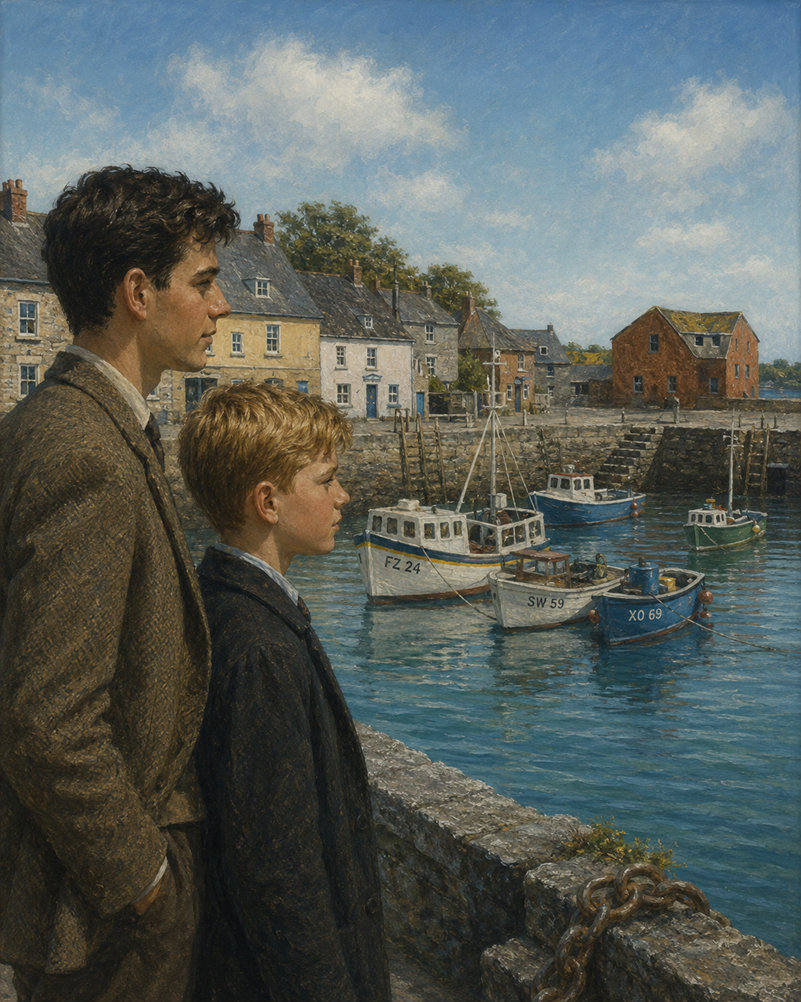
During that week we explored the little town, its harbour and the surrounding countryside. We walked many a mile side by side, while he told me tales of the old Cornish saints, pointed out things of interest, even a few words of the Cornish language which very few people then spoke. I hear that there is now a flourishing revival of the language, as there was a few years ago of the Welsh language which is now widely spoken across the Principality. Many times, when we were out together, he would put a hand on my shoulder whilst pointing out some feature of the landscape: a church, perhaps, with an unusual spire, or a hill with an interesting legend attached to it.
I ate heartily of Mrs Pascoe’s delightful cooking. Her Cornish Pasties, one of which we took with us each day for luncheon on our rambles, were masterpieces of light, crisp pastry filled with tender, delicately spiced meat and vegetables. I had a boy’s hearty appetite and did ample justice to the homely but tasty and filling suppers she provided.
The week was over all too soon, and we made ready to return to school. For some reason connected with the railway timetable, it would not be possible to make the entire journey on the Sunday, and we were therefore to travel to London on the Saturday, stay overnight at an hotel, and make the further journey to school on the Sunday. Accordingly, we left Penzance – after many kindly farewells and many promises that I would visit again – and arrived at Paddington in the afternoon. The hotel was a large, rather grimy structure not far from the station, and we made our way there on foot.
The porter took us up to our room. Mr Pascoe was much surprised to find that we had only one room, when he was quite sure that he had booked two. However, there were apparently no other rooms available, and I certainly had no objection to sharing a room with someone else; far from it, as I was well accustomed to being in a dormitory with half a dozen other boys.
The room was of moderate size, and contained two beds, a double and a single, separated by a pair of pedestal cupboards. There were curtains, but they were thin and did not meet in the middle. There were a chipped washbasin and a rickety towel stand. The whole place had a rather dusty, flyblown air. I remember, too, that the bedside light did not work, and so we had to read by the light of a rather inadequate ceiling fitting. Mr Pascoe turned out the ceiling light, and we disposed ourselves to sleep.
Sleep, however, did not come easily. The strangeness of the place was no doubt responsible, and it was not helped by the lumpiness of the mattress and pillow. I lay awake for perhaps an hour, listening to the sounds of traffic in the street outside, watching the beams from headlights of passing cars move across the ceiling. Then I discovered that I needed to pee. I slid out of bed and along the corridor to the lavatory. Returning to our rather dismal room, I closed the door, then paused.
“Why not?” I thought. I remember that moment with utter clarity. And I moved, not to my bed, but to Mr Pascoe’s, lifted the sheets and climbed in next to him, my heart beating as if it would burst out of my chest.
He woke, if he had been asleep, and moved over, making room for me. Then he murmured, “turn on your side”. I did so, and one of his arms slid under my head, while the other was folded over my side. I lay, my back folded into the warm, welcoming curve of his torso and legs, held in his arms, suddenly feeling utterly secure and at ease. I knew with absolute certainty that this was what I had wanted for a long time.
[1] The 'Tube' is the underground electric railway which provides the best part of London's public transport system.
Comments powered by CComment