
BEASTS ARE RATIONAL BY PLUTARCH
Beasts are Rational Περὶ τοῦ τὰ ἄλογα λόγῳ χρῆσθαι by the Boiotian Greek historian and philosopher Plutarch Πλούταρχος of Chaironeia (ca. AD 46-120) who won Roman imperial favour and rose to become procurator of Achaia, was one of the many components of his Moralia (985c-992), written around AD 100. It is a lively imagined dialogue, in which Gryllus, a young Boiotian who has been transformed into a pig by the sorceress Circe, explains (at her request) to the hero Odysseus why beasts are more virtuous than people and he thus prefers being one.
Presented here is the only passage in it alluding to Greek love. The translation is by Paul A. Clement in Moralia, Volume VIII, the Loeb Classical Library Volume 424, published by William Heinemann in London in 1969. His romanisations of Greek names have been replaced by transliterations of the Greek.
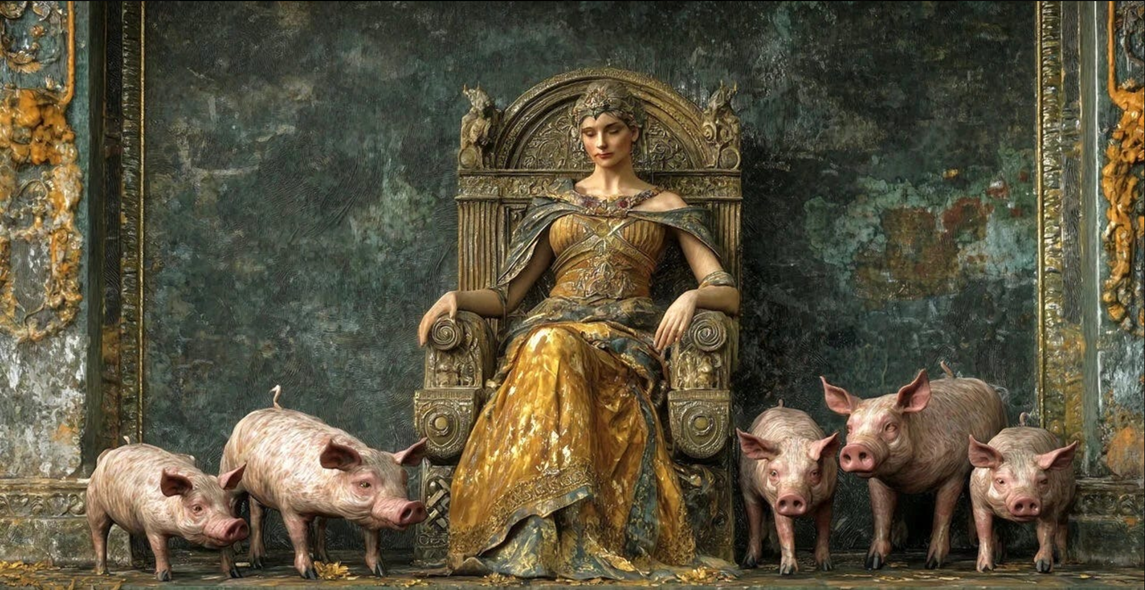
990d-991a
| Whence it comes about that to this very day the desires of beasts have encompassed no homosexual mating.[1] But you have a fair amount of such trafficking among your high and mighty nobility, to say nothing of the baser sort. Agamemnon came to Boiotia hunting for Argynnos, who tried to elude him, and slandering the sea and winds ... then he gave his noble self a noble bath in Lake Copaïs to drown his passion there and get rid of his desire.[2] Just so Herakles, pursuing a beardless lad, lagged behind the other heroes and deserted the expedition.[3] On the Rotunda of Ptoian Apollo one of your men secretly inscribed FAIR IS ACHILLES—when Achilles already had a son.[4] And I hear that the inscription is still in place. But a cock that mounts another for the lack of a female is burned alive because some prophet or seer declares that such an event is an important and terrible omen. On this basis even men themselves acknowledge that beasts have a better claim to temperance and the non-violation of nature in their pleasures. Not even Nature, with Law for her ally, can keep within bounds the unchastened vice of your hearts; but as though swept by the current of their lusts beyond the barrier at many points, men do such deeds as wantonly outrage Nature, upset her order, and confuse her distinctions. | [d] ὅθεν οὔτ᾿ ἄρρενος πρὸς ἄρρεν οὔτε θήλεος πρὸς θῆλυ μῖξιν αἱ τῶν θηρίων ἐπιθυμίαι μέχρι γε νῦν ἐνηνόχασιν. ὑμῶν δὲ πολλὰ τοιαῦτα τῶν σεμνῶν καὶ ἀγαθῶν· ἐῶ γὰρ τοὺς οὐδενὸς ἀξίους· ὁ δ᾿ Ἀγαμέμνων τὴν Βοιωτίαν ἐπῆλθε κυνηγετῶν τὸν Ἄργυννον ὑποφεύγοντα καὶ καταψευδόμενος τῆς θαλάσσης καὶ Eτῶν πνευμάτων . . . εἶτα καλὸν καλῶς ἑαυτὸν βαπτίζων εἰς τὴν Κωπαΐδα λίμνην, ὡς αὐτόθι κατασβέσων τὸν ἔρωτα καὶ τῆς ἐπιθυμίας ἀπαλλαξόμενος. ὁ δ᾿ Ἡρακλῆς ὁμοίως ἑταῖρον ἀγένειον ἐπιδιώκων ἀπελείφθη τῶν ἀριστέων καὶ προύδωκε τὸν στόλον· ἐν δὲ τῇ θόλῳ τοῦ Πτῴου Ἀπόλλωνος λαθών τις ὑμῶν ἐνέγραψεν “Ἀχιλλεὺς καλός,” ἤδη τοῦ Ἀχιλλέως υἱὸν ἔχοντος· καὶ τὰ γράμματα πυνθάνομαι διαμένειν. ἀλεκτρυὼν δ᾿ ἀλεκτρυόνος ἐπιβαίνων, θηλείας μὴ παρούσης, καταπίμπραται ζωός, μάντεώς τινος ἢ τερατοσκόπου μέγα καὶ δεινὸν ἀποφαίνοντος εἶναι τὸ γινόμενον. οὕτω καὶ παρ᾿ αὐτῶν ἀνωμολόγηται τῶν ἀνθρώπων, ὅτι μᾶλλον Fτοῖς θηρίοις σωφρονεῖν προσήκει καὶ μὴ παραβιάζεσθαι ταῖς ἡδοναῖς τὴν φύσιν. τὰ δ᾿ ἐν ὑμῖν ἀκόλαστα οὐδὲ τὸν νόμον ἔχουσα σύμμαχον ἡ φύσις ἐντὸς ὅρων καθείργνυσιν, ἀλλ᾿ ὥσπερ ὑπὸ ῥεύματος ἐκφερόμενα πολλαχοῦ ταῖς ἐπιθυμίαις δεινὴν ὕβριν καὶ ταραχὴν καὶ σύγχυσιν ἐν τοῖς ἀφροδισίοις ἀπεργάζεται τῆς φύσεως. |
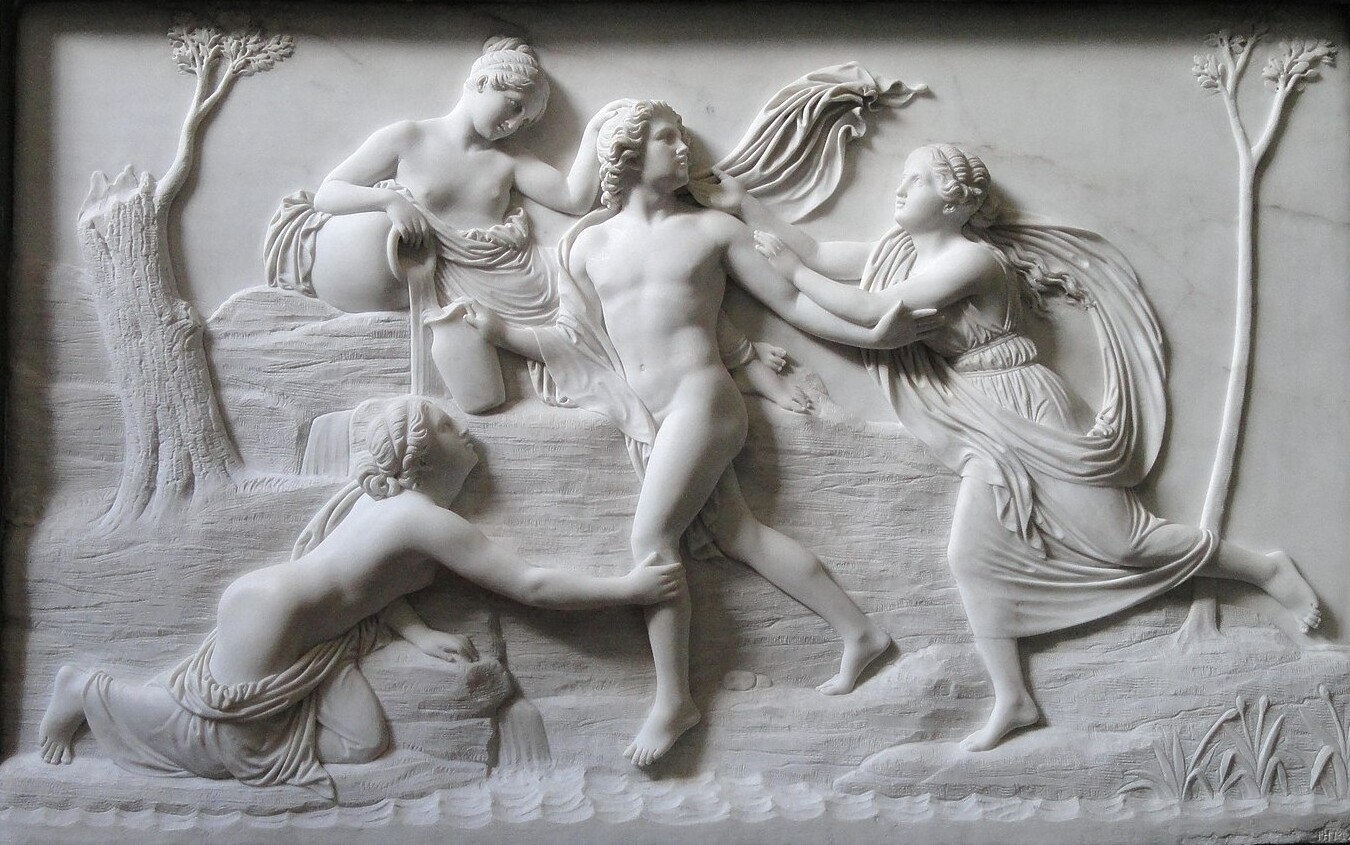
Hylas Stolen by the Water Nymphs by Bertel Thorvaldsen
The argument continues in the same vein with mention of the lusts of men and women for beasts, whereas beasts have never sought sex with humans.
[1] Cf. Plato, Laws, 836 c; but see Pliny, Nat. Hist. x. 166; Aelian, De Natura Animal, xv. 11; Varia Hist. i. 15; al., [Translator’s note]
[2] Other ancients add that Argynnos was a boy of royal Theban descent (Stephanos of Byzantium, Gazetteer A 114.8), that Agamemnon fell in love with him “having seen him swimming in the Kephisos river; in which, in fact, he lost his life (for he constantly bathed in this river), and Agamemnon buried him and founded there a temple of Aphrodite Argynnis” (Athenaios, The Learned Banqueters 603d), and that it was on account of falling in love with him that Agamemnon temporarily forgot his duty to lead the assembled Greek armies against Troy (Phanokles fragment 5), leading to his failing to set sail at the opportune time and having to sacrifice his daughter Iphigenia (Propertius, Elegies III 7 xxi-xxiv), with further dire repercussions.
[3] Herakles took his loved by Hylas on the expedition of the Argonauts. Hylas disappeared, dragged into a pool by an amorous Naiad (fresh-water nymph) when drawing water, causing Herakles to abandon the expedition to search in vain for him. (Apollodoros, Library I 1207-1272)
[4] Ptoian Apollo was a famous shrine in Boiotia. Achilles fathered his only two children in Skyros as a beautiful boy of fifteen, while hidden there disguised as a girl to prevent his being taken on the war against Troy. (Euripides, Skyrioi (fragments); Philostratos the younger, Imagines I; Scholiast on Homer’s Iliad, IX 326; Ovid, Metamorphoses XIII 162–180; Ovid, Tristia II 409–412; Pseudo-Apollodorus, Library III 13 viii; Statius, Achilleid I 689–880, II 167ff.)
Comments powered by CComment