
THE ROMAN QUESTIONS
BY PLUTARCH
The Roman Questions Αἴτια Ῥωμαϊκά, an explanation of various Roman customs by the Boiotian Greek historian and philosopher Plutarch Πλούταρχος of Chaironeia (ca. AD 46-120) who won Roman imperial favour and rose to become procurator of Achaia, was one of the many essays in his Moralia, written around ca. AD 100. The translation is by Frank Cole Babbitt in Moralia, Volume IV, the Loeb Classical Library Volume 305 published by William Heinemann in London in 1936.
274a-e
[40] Why is it not allowed the priest of Jupiter (Flamen Dialis) to anoint himself in the open air? Διὰ τί τῷ ἱερεῖ τοῦ Διὸς οὐκ ἔξεστιν ἐν ὑπαίθρῳ ἀλείφεσθαι;
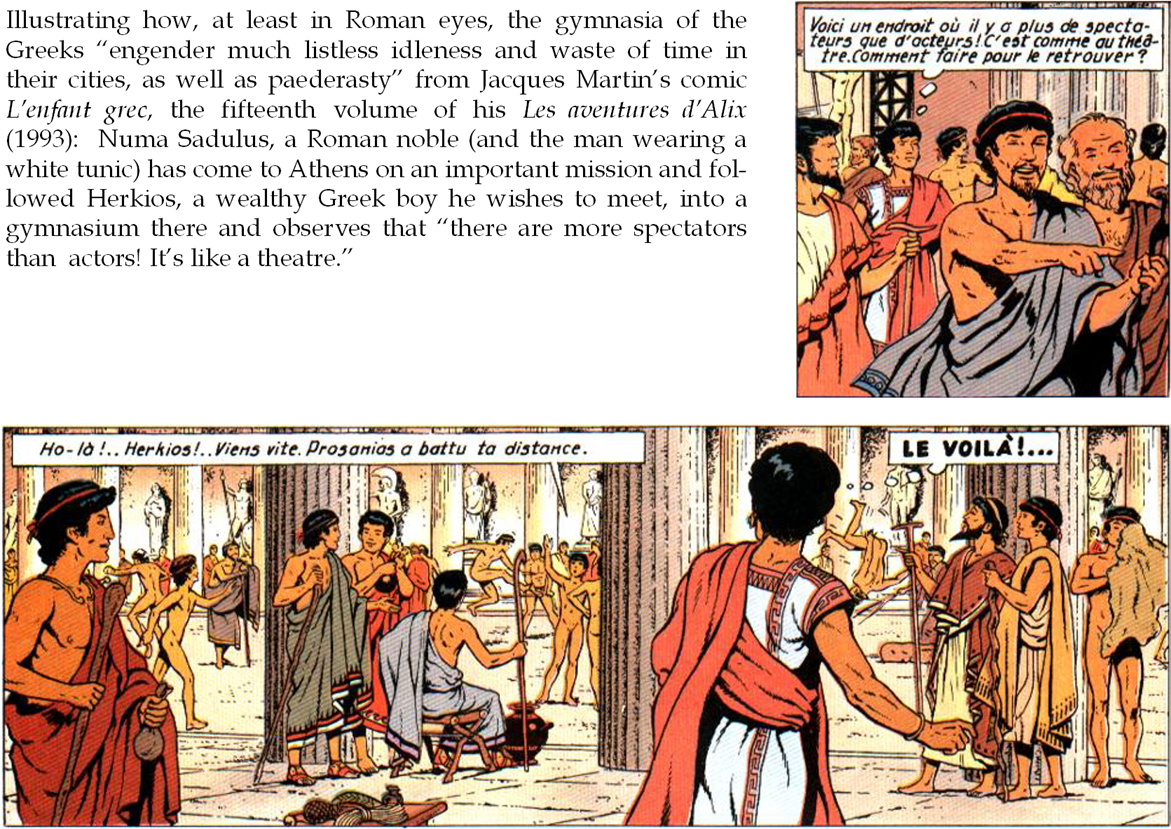
| […] For the Romans used to be very suspicious of rubbing down with oil, and even to‑day they believe that nothing has been so much to blame for the enslavement and effeminacy of the Greeks as their gymnasia and wrestling-schools, which engender much listless idleness and waste of time in their cities, as well as paederasty and the ruin of the bodies of the young men with regulated sleeping, walking, rhythmical movements, and strict diet; by these practices they have unconsciously lapsed from the practice of arms, and have become content to be termed nimble athletes and handsome wrestlers rather than excellent men-at‑arms and horsemen. It is hard work, at any rate, when men strip in the open air, to escape these consequences; but those who anoint themselves and care for their bodies in their own houses commit no offence. | [… 274d] πολλὰ δ᾿ ἄλλα δηλοῦται πᾶσι διὰ τοῦ ἱερέως· ὧν ἕν ἐστι καὶ τὸ ἐν ὑπαίθρῳ μὴ ἀλείφεσθαι. τὸ γὰρ ξηραλοιφεῖν ὑφεωρῶντο Ῥωμαῖοι σφόδρα, καὶ τοῖς Ἕλλησιν οἴονται μηδὲν οὕτως αἴτιον δουλείας γεγονέναι καὶ μαλακίας ὡς τὰ γυμνάσια καὶ τὰς παλαίστρας πολὺν ἄλυν καὶ σχολὴν ἐντικτούσας ταῖς πόλεσι καὶ κακοσχολίαν καὶ τὸ παιδεραστεῖν καὶ τὸ διαφθείρειν τὰ σώματα τῶν νέων ὕπνοις καὶ περιπάτοις καὶ κινήσεσιν εὐρύθμοις καὶ διαίταις ἀκριβέσιν, ὑφ᾿ ὧν ἔλαθον ἐκρυέντες τῶν ὅπλων καὶ ἀγαπήσαντες ἀνθ᾿ ὁπλιτῶν καὶ ἱππέων ἀγαθῶν εὐτράπελοι καὶ παλαιστρῖται καλοὶ λέγεσθαι. [e] ταῦτα γοῦν ἔργον ἐστὶν ἀποφυγεῖν εἰς ὕπαιθρον ἀποδυομένους· οἱ δὲ κατ᾿ οἰκίαν ἀλειφόμενοι καὶ θεραπεύοντες ἑαυτοὺς οὐδὲν ἁμαρτάνουσι. |
287f-288b
[101] Why do they adorn their children's necks with amulets which they call bullae? Διὰ τί κοσμοῦσι τοὺς παῖδας τοῖς περιδεραίοις, ἃ βούλλας καλοῦσι;
| […] Or did the Romans of early times account it not disreputable nor disgraceful to love male slaves in the flower of youth, as even now their comedies[1] testify, but they strictly refrained from boys of free birth; and that they might not be in any uncertainty, even when they encountered them unclad, did the boys wear this badge? | [… 288a] Ἢ τοῖς παλαιοῖς οἰκετῶν μὲν ἐρᾶν ὥραν ἐχόντων οὐκ ἦν ἄδοξον οὐδ᾿ αἰσχρόν, ὡς ἔτι νῦν αἱ κωμῳδίαι μαρτυροῦσιν, ἐλευθέρων δὲ παίδων ἰσχυρῶς ἀπείχοντο, καὶ ὅπως μηδὲ γυμνοῖς ἐντυχόντες ἀμφιγνοήσειαν, [b] ἐφόρουν οἱ παῖδες τὸ παράσημον; |
[1] The so‑called togatae, of which no complete specimen has survived; the palliatae of Plautus and Terence, being based on the Greek New Comedy, would prove nothing. [Translator’s note]
Comments powered by CComment