
THE MOVING PICTURE BOY ARCHIVE
A REVIEW OF THE FILM IS ANYBODY THERE? (2008)
by Sam Hall
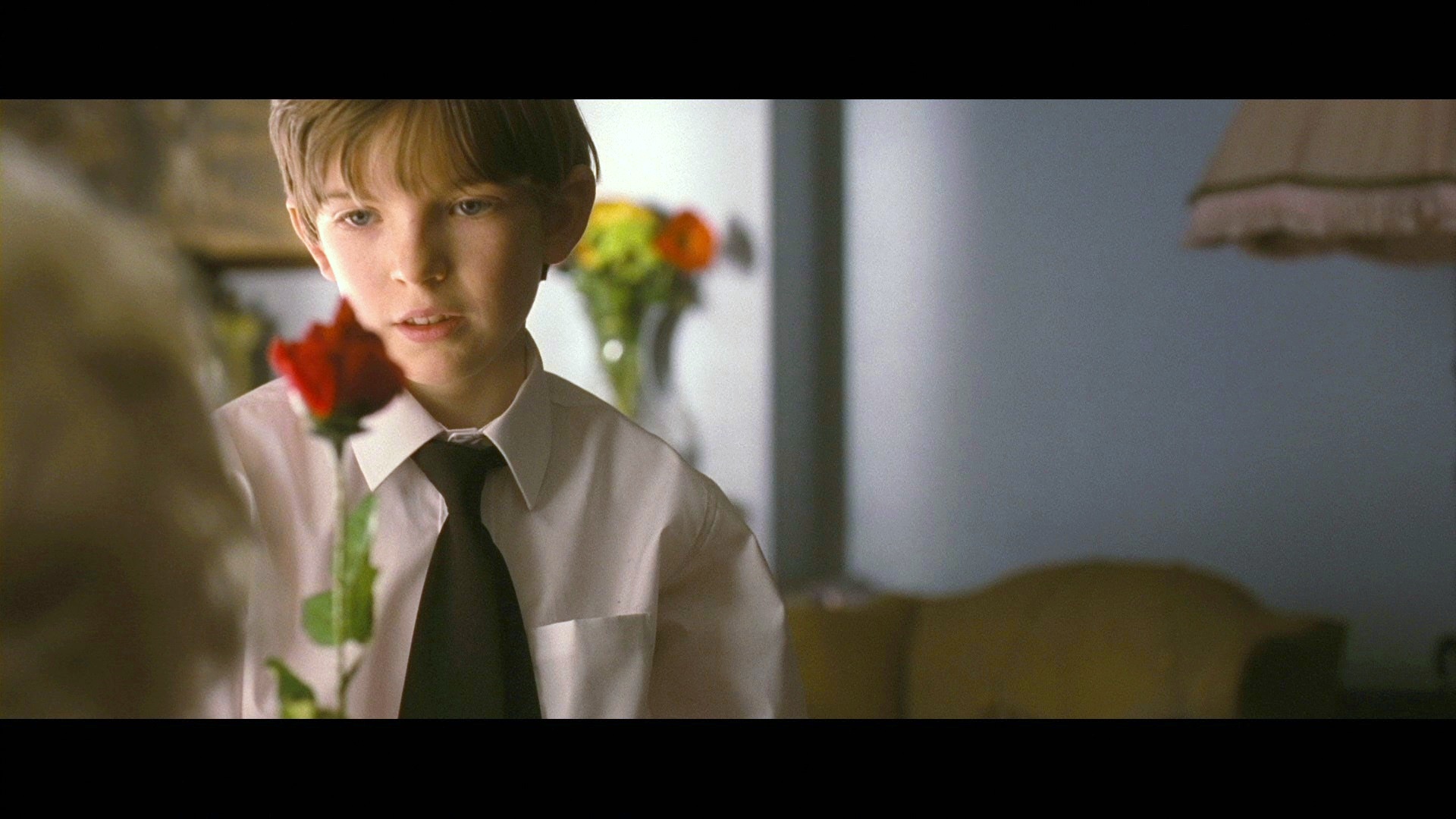
The 2008 British film Is Anybody There? was directed by John Crowley -- notable for such films as Boy A (2007) and The Goldfinch (2019) -- and starred Bill Milner and Michael Caine. This was Milner's second theatrical movie, after Son of Rambow (2007). Movie poster image and screenshots (enhanced to increase brightness) were supplied by the Editor. Clicking on any image will open the full-size image in a new tab.
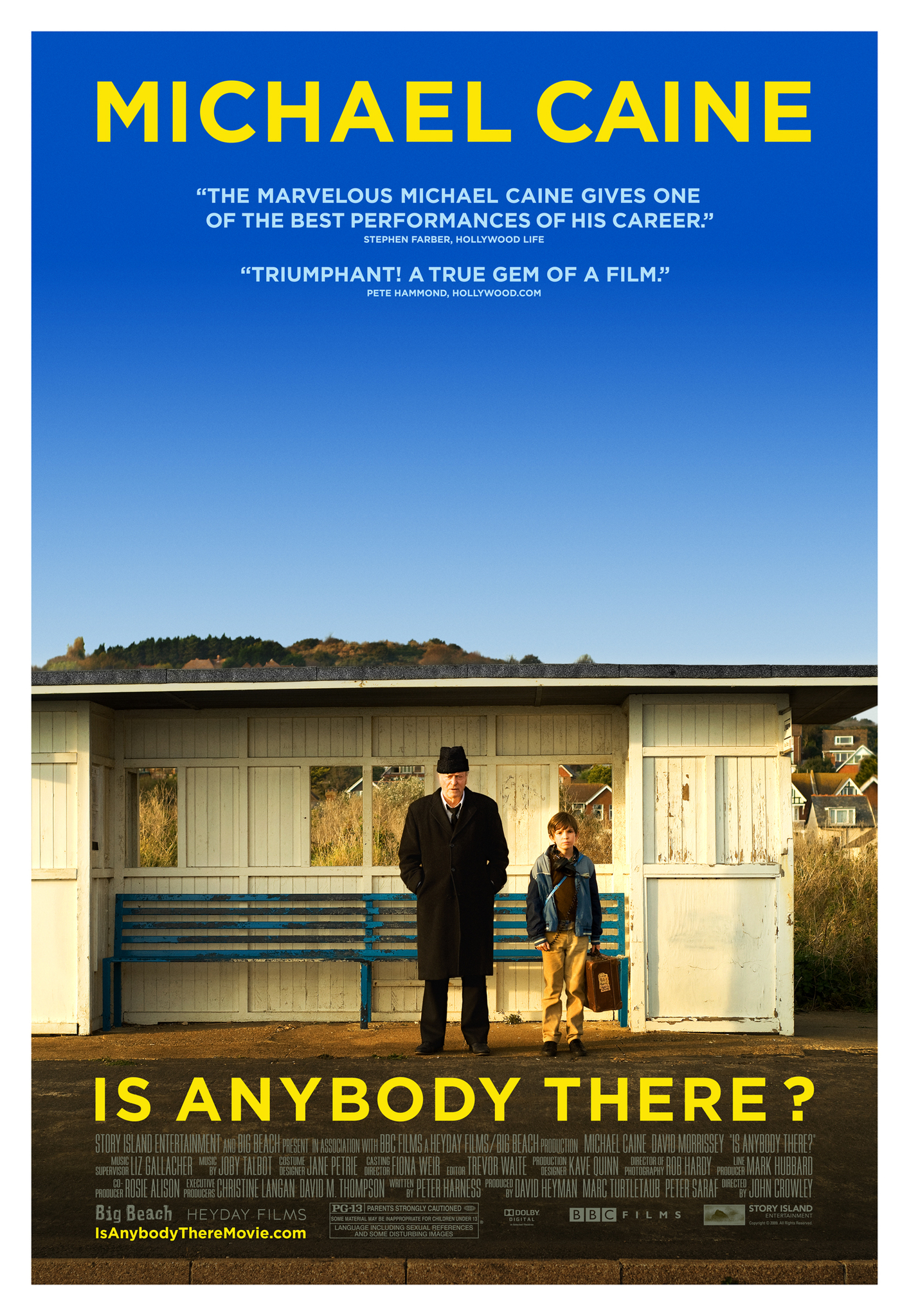 Edward, an eleven-year-old boy, finds himself trapped in a world of decrepit last-gasp geezers with nothing to look forward to but further decline, senility and death. No, it's not a hard-hitting look at Western Civilisation, but the quirky setup for a tale of unlikely friendship between a boy and an elderly man. The film's opening sees both boy and man struggling with their own looming big-ticket items, puberty and death, and the result is a relationship whose emotional and psychological significance far outweighs its brevity.
Edward's parents, a year before the film opens, turned their family abode into an old folks' home. The boy's been shunted from his room into a pokey little attic to make way for a paying geezer. Understandably, he doesn't like it. His former normal life has been lost, submerged under the round-the-clock needs of the old and infirm. Bill Milner, the actor playing Edward, brings this kid to life with some wonderful acting; there's not a false note or muffed inflection in his entire lead-role performance, rare for an actor his age. Oddly, reviews of the film tend to direct their praise toward Michael Caine's effort as the old curmudgeon Clarence, suggesting that the film's title Is Anybody There? is apt and works on levels. Sure, Caine's performance is strong, excellent if you like, but then the sun also rose in the east yesterday and no one feels the need to bang on about that.
The way Edward responds to the dreary mothballing of his childhood is quite magnificent. He makes the dying elderly his grand passion -- for they do keel over with helpful regularity. With his trusty tape recorder and meticulous observation, Edward sets out to discover the mystery of death. Does it harbour an after-life? How exactly does the change from alive to dead take place? What do the weird final snuffling noises mean? He senses a possible communication is being attempted from this shadowy realm. Every cultural achievement from Augustine to Newton is summed up in this plucky boy's determination to crack nature's secret codes. On his own, ignoring the nay-sayers and the chiders, he refuses to accept the dreariness of his daily round. There has to be something more! He is a credit to a tradition that seems to have lost its way and would now prefer a good lie down.
Enter, The Amazing Clarence: an amazingly bitter, miserable old ex-magician who meets Edward by almost running him down then leaping from his van like a Dickensian ogre to try and throttle him. Edward soon fights back, then embittered Clarence tries to kill himself, and the two-against-the-world friendship is forged. Caine's miserable old sod is uncompromisingly rendered. Even as Clarence shows admirable sentiments and actions toward the boy, he remains in character -- no Scrooge miracles here -- and its none too attractive. But he is the perfect foil for Edward who is after all obsessed with investigating death. And hoary death could have no better ambassador than Clarence, who spends the film hacking and staggering one bitter recrimination short of a wished-for and meaningless end.
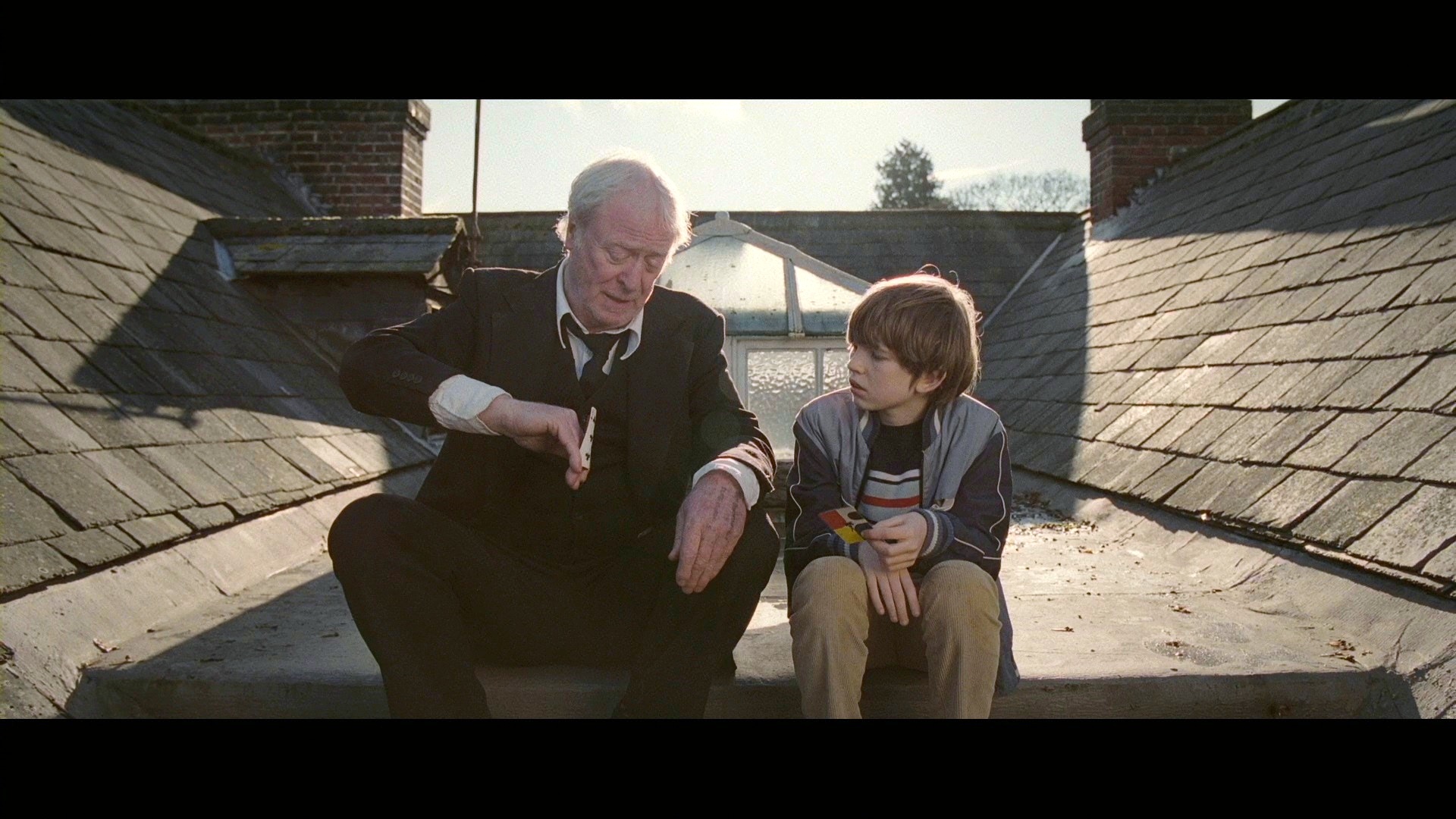
It's in the shadowy near-death terrain shared by man and boy that this special friendship film proves it's worth. After birth, the two greatest changes we experience are puberty and death. Tribal puberty rites often involve a boy's "dying" as a child and returning as a man. Edward's eleventh birthday is a central plot marker of the film, so his approach to puberty is paramount. Clearly, his investigation of the second great change, death, is informed by anxieties provoked by the first. What will happen? Will there be life after death? What will it be like? Edward, ever the pragmatic explorer of exotic mysteries, repeatedly confirms the nature of his interest. Well meaning mum keeps telling her son he needn't be afraid of death, to which he impatiently replies, "I just want to know what happens!" His dad is lost to an early mid-life crisis, he has no friends, he lives with people who eat napkins and sing along to the Wiggles. Is it any wonder the boy looked to the supernatural for answers?
Unfortunately, Edward's life in the old folks' home has either caused or coincided with a decline in his social fortunes at school. Boys who were probably former friends now avoid him and call him a weirdo. This is often the fate of those marked out by creativity or intellect. But we get the impression this isn't Edward's rightful path. He's taken a wrong turn and could do with a hand getting back on track. Certainly Clarence sees it that way. His efforts to guide Edward away from his death obsession toward something more socially engaged turns out to be a boon not just for the boy but for himself as well. For the first time we see Clarence without a grim fixation on his own misery, and it's surely as much relief for him as it is for us. It's notable that Clarence angrily rejects all institutional sops and saps eager to anaesthetise his final run home to the last great change. "Rage, rage, against the dying of the light," he recites. His raging wasn't pretty. It seemed more nasty and petty and vindictive than philosophical, but it did see him win a brief but meaningful connection with an eleven-year-old boy. One could even argue that Clarence's dying light redirected at the last minute to help pass down the fragile flame of masculinity for one more shot at glory or bust. Sure, in the end, it's always a bust, but that doesn't entirely preclude the glory.
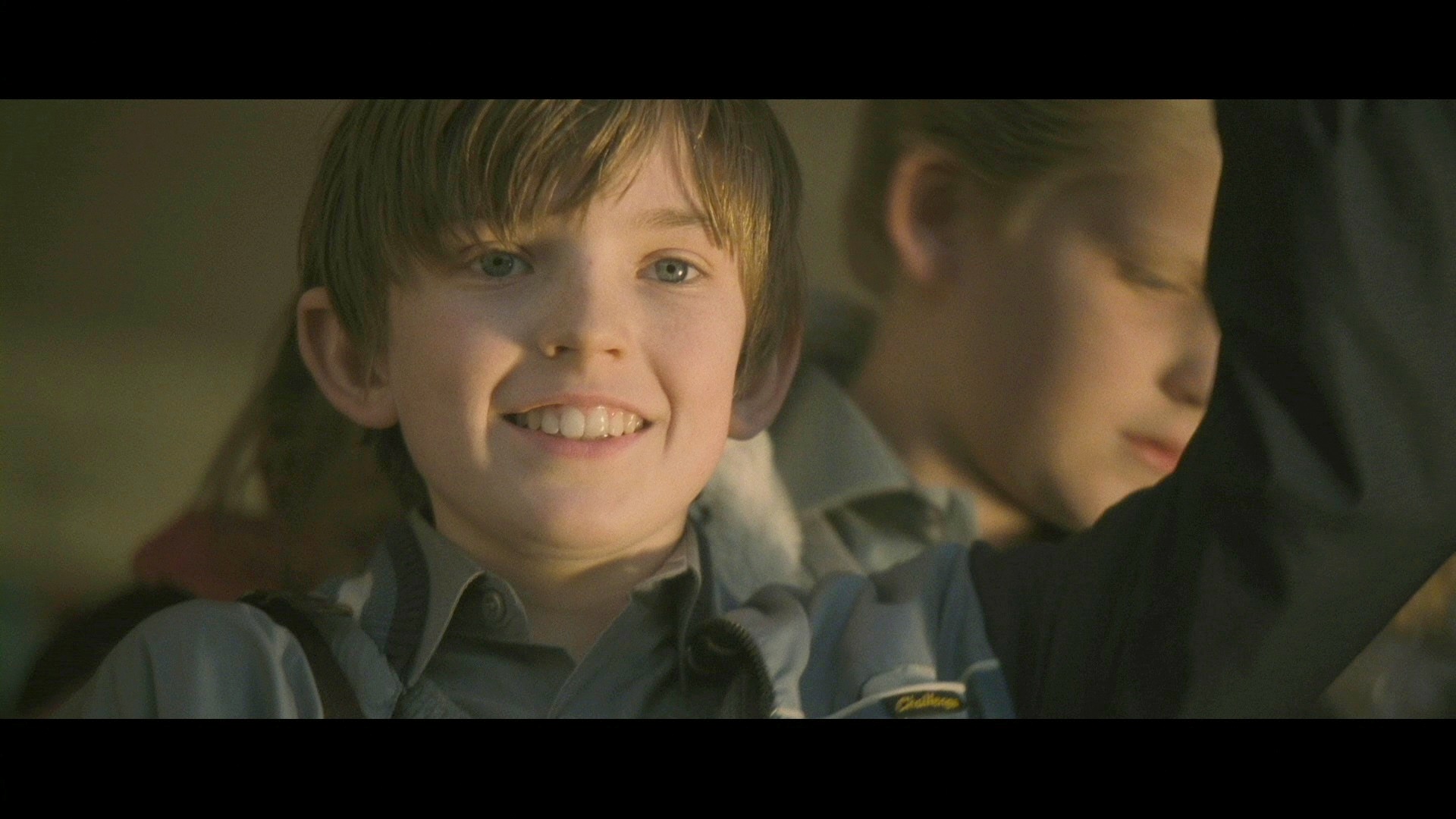
Clarence -- The Amazing Clarence -- being an ex-magician was plot-perfect. From the moment Edward found out Clarence knew magic tricks, his interest in mysteries began to move from solo infatuation with the unknowable to an apprentice's interest in creating illusion. It was also a move from evading his own life-situation to meaningfully engaging with it. Clarence's lessons were archetypal, teaching the boy knowledge and mastery of his own body. The spotlight was on the boy's abilities, his physical skill and coordination and also, importantly, his showmanship, his ticket back toward social integration. With that sort of attention, predictably enough he bloomed. To make a card disappear with casual panache takes a lot of practice. Edward only achieved it right at the end, just before Clarence died, but his use of Clarence's teachings to re-enter society was already well underway.
Clarence's miserable-old-bugger persona had other sweet spots. The boy's first wide-eyed question to him was, "Are you a magician?" to which Clarence replies, "No, I'm a retired flasher." Making a phallus appear so suddenly and unexpectedly showed his connection to magic wasn't entirely severed. He followed this up when waiting with a group of mums to pick Edward up after school. A frowning mum frumped over to ask, "You waiting for someone?"
Clarence replied, "Yes, a little lad."
After an unhappy pause, frowning mum asked, "Your grandson, is it?"
"No," said Clarence with a rare note of jauntiness. "Just a little lad."
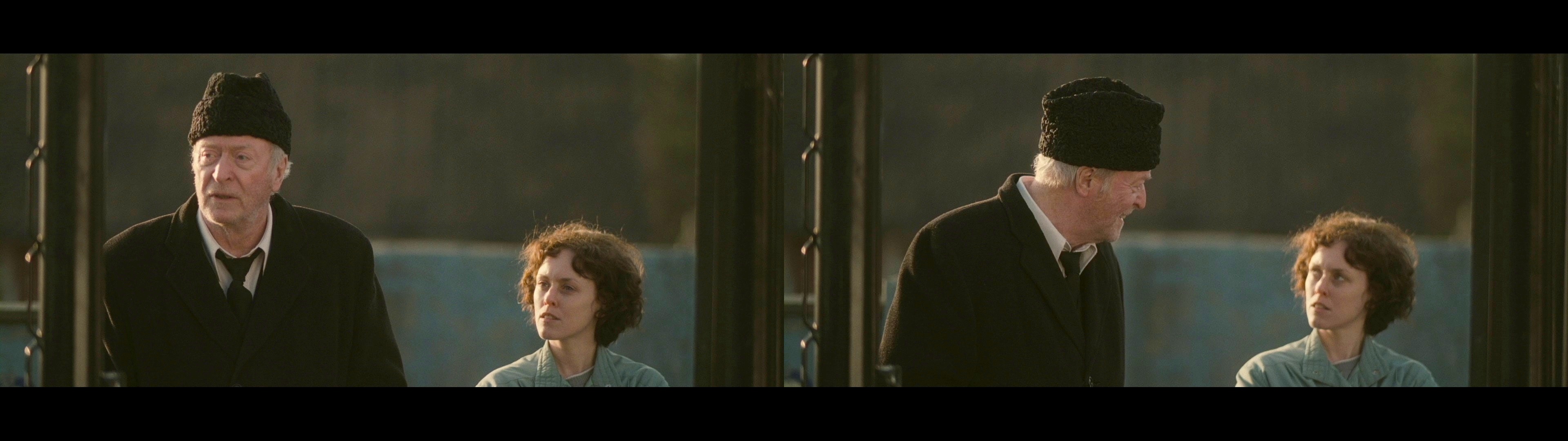
Long live curmudgeons. Was there ever an official meeting? Were minutes taken? When men decided it was fine by them to hand over complete care and control of boys to the womenfolk? Something about that decision chimes with the opening sentence of this review.
The setting of this film prompts some serious reflection. The boy's normal nuclear family was transformed into something resembling a gone-to-seed nightmare from the days of hippy communes. It's possible this move was causing Edward problems fitting in at school. His immersion in the Mad Hatter incontinence of the oldies, his fixation on their constant dying, can't have helped him build good social strategies in the playground. But kids entering puberty don't need external factors to go off the rails. It can happen in the best homes. One advantage Edward had was a home environment which enabled him to form a close and meaningful friendship with a man like Clarence. It is a friendship which, as our frowning mum reminded us, is not allowed today.
The sixties' revolutionaries were in part busting open a nuclear family model found suffocating in its suburban isolation and inwardly curdling sexual energies. They blew it, of course, as they blew their whole crack-pot hodgepodge of naivety and vulgarity. But it doesn't mean they didn't diagnose a problem worth addressing. Witness today the increasingly loopy upper-middle-class kids arriving at America's elite universities. Their worldviews are not being formed in places that can smugly claim superiority to Edward's mad living arrangements. And they sure as hell could have done with a spitting-chips ogre like The Amazing Clarence early in their lives.
There's a nice hint of Shamanic journey in Is Anybody There?. Edward "dies" and leaves normal society to travel through a strange otherworld. There he meets an important spirit guide in the form of The Amazing Clarence. This is given a playful tweak in the form of Clarence's fondness for badgers. Edward at one point is pestering Clarence to come visit him after he dies, to give him the knowledge he craves. Clarence's faculties are dimming, and he can only ramble on about how much he likes badgers, how he'd like to come back as a badger, before adding, apropos of nothing, "they make sporrans out of badgers". The very last scene sees Edward, having mourned Clarence's death, now happily at play with a new friend. At one point he rushes off to retrieve a ball from the bushes. A badger appears and scurries across his path, causing a big, mystery-acknowledging grin from Edward. What boy, embarking on the serious pubertal business of developing his own sporran, wouldn't be thrilled to link it magically to an amazing friend?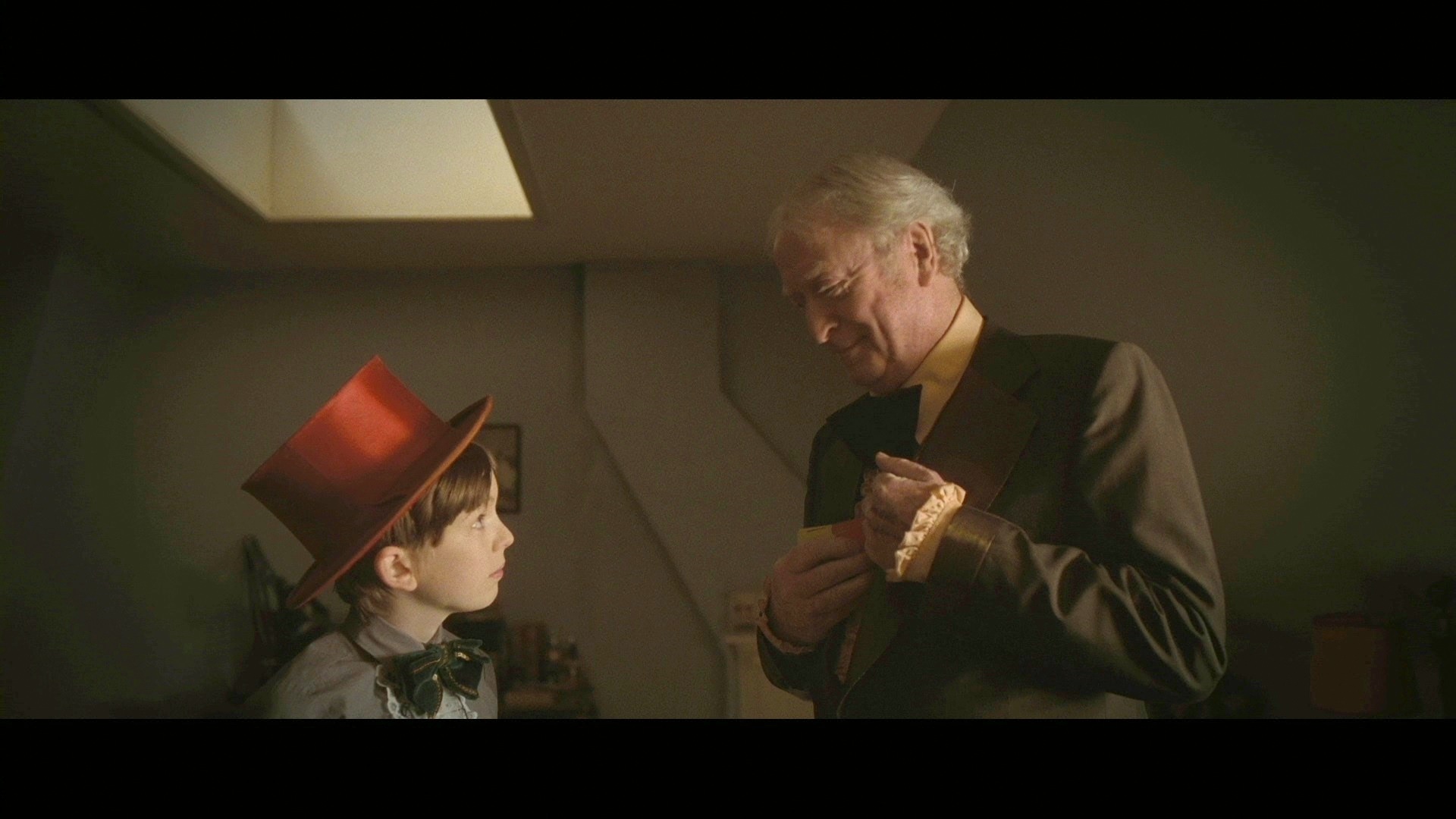
If you would like to see one of your own movie reviews published in the Archive, then please send your review to mpba@tutamail.com, along with the pseudonym by which you wish to be known on this site.
Comments powered by CComment